




(0) Items
There is a particular kind of exhaustion that comes from reading a skincare label. Ingredient lists that read like chemistry homework. Claims that contradict each other across products from the same brand. The slow realization that "natural" on the front of a bottle means almost nothing without certification to back it up.
This is the landscape Miranda Kerr was navigating when she founded KORA Organics, and it is the same landscape millions of consumers are pushing back against right now. The timing is not coincidental.
Clean Beauty Has Grown Up
For years, "clean beauty" was more aesthetic than standard. It meant beige packaging and vague botanical references. It rarely meant rigorous certification, supply chain transparency, or formulas that could hold their own against conventional skincare in clinical outcomes.
That has changed. Consumer expectations have shifted sharply toward accountability. Shoppers are asking not just what is in a product, but how the ingredients were sourced, whether the brand has third-party certification, and whether the formula actually works or simply avoids a list of flagged ingredients. A 2023 survey by the Clean Beauty Summit found that over 70% of clean beauty consumers now say certification matters more to them than marketing language when making a purchase decision.
KORA Organics was built for this moment. Every product in the range is certified organic, vegan, gluten-free, cruelty-free, and non-GMO. Certified organic formulations contain up to 60% more antioxidants than their non-organic counterparts. That is not a marketing position. It is a measurable difference in what the skin receives.
The Problem With Compromise
The most persistent frustration in modern skincare is the assumption that efficacy and ethics cannot coexist. Consumers who want clean formulas are often told, implicitly or explicitly, to accept less performance. Consumers who want results are steered toward synthetic actives with long track records and no particular interest in sustainability.
KORA Organics rejects that binary entirely. Its product development starts with organic, plant-derived ingredients and works forward to clinical results, not the other way around.
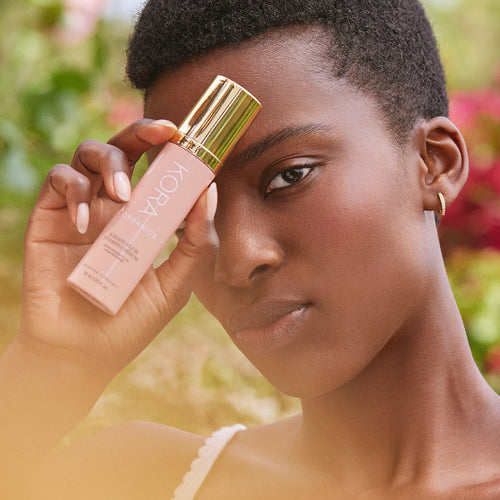
The Turmeric Glow Drops Niacinamide Alternative Serum is a direct response to a real problem: niacinamide is one of the most popular brightening actives in mainstream skincare, but it causes flushing and irritation for a significant portion of users. KORA's formulation uses organic turmeric and plant-based alternatives that deliver comparable brightening and pore-refining results without the sensitivity risk. Independent consumer studies found that 92% of users saw improved skin texture. That is not a compromise. That is a solution.

Turmeric Glow Drops Niacinamide Alternative Serum — $$79.00
Ingredients With a Reason to Be There
One of the clearest expressions of KORA's philosophy is ingredient intentionality. Nothing is included for trend value alone. Every key ingredient has a functional reason to be in the formula, and many are sourced from regions where they have been used medicinally for generations.
Kakadu plum is one of the most concentrated natural sources of Vitamin C on earth, containing up to 100 times more Vitamin C than an orange. The Kakadu Plum Vitamin C Eye Cream addresses a specific problem that most eye creams sidestep: the delicate orbital area needs brightening and antioxidant protection, but it is also the first place irritation shows up when a formula is too aggressive. Using Kakadu plum as the Vitamin C source allows for high-potency brightening without the instability and potential irritation of synthetic ascorbic acid.

Kakadu Plum Vitamin C Eye Cream — $$64.00
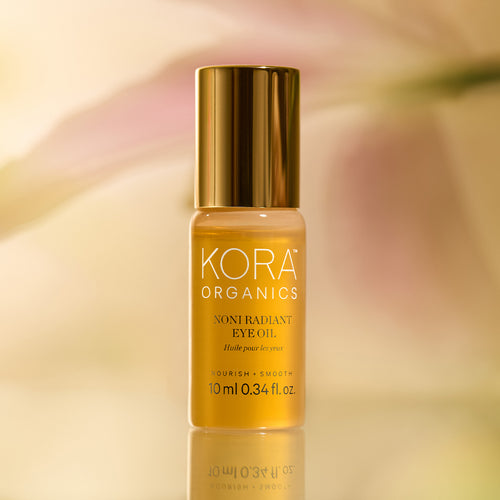
Noni fruit, the cornerstone of the Noni Glow Face Oil, has been used in Polynesian wellness traditions for centuries. Rich in fatty acids and antioxidants, it addresses the specific problem of lipid loss in the skin barrier, which accelerates with age and environmental exposure. Face oils have surged in popularity as consumers recognize that hydration and moisture retention are not the same thing, and that water-based moisturizers alone cannot compensate for a compromised barrier. The Noni Glow Face Oil exists precisely at that intersection.

Noni Glow Face Oil — $$78.00
Hydration as a Category Is Being Redefined
The moisturizer category is undergoing a genuine shift. Consumers are moving away from heavy, occlusive creams toward formulas that hydrate without weight, particularly as layering multiple actives has become standard practice. A moisturizer that sits on top of a serum stack rather than working with it creates problems: pilling, interference with absorption, and a finish that feels wrong under SPF or makeup.
The Active Algae Lightweight Moisturizer addresses this directly. Microalgae is one of the more compelling recent additions to serious skincare formulation. It delivers deep hydration and supports the skin's natural moisture-retention mechanisms without the heaviness associated with traditional emollients. For anyone who has abandoned moisturizer mid-routine because it interfered with what came before or after, this formula solves the sequencing problem.

Active Algae Lightweight Moisturizer — $$64.00
For those whose skin needs more from a moisturizer, the Turmeric Glow Moisturizer pairs organic turmeric with licorice root to address dullness and uneven tone at the hydration step, rather than requiring a separate brightening layer. It is a consolidation of function that reflects how consumers are increasingly thinking about their routines: fewer products, higher performance per step.

Turmeric Glow Moisturizer — $$68.00
What the Brand Actually Stands For
KORA Organics occupies a specific and increasingly important position: it is not a mass-market brand that added an organic line, and it is not a wellness brand that wandered into skincare. It was built from the ground up around the principle that organic certification, clinical efficacy, and environmental responsibility are not trade-offs. They are the standard.
The brand's packaging uses recycled materials. Its supply chain is held to a climate-neutral standard. Its founder built the company around her own convictions about what skincare should be, not around a gap in the market that needed filling with whatever would sell.
That origin matters. Brands built around a point of view tend to make more coherent decisions over time. The formulas reflect the values, the values reflect the founder, and the founder's commitment to holistic wellbeing runs through every product on the shelf.
In a market where the gap between what brands claim and what they deliver has never been more scrutinized, KORA Organics exists as a brand that built its credibility before the scrutiny arrived. That is a harder thing to manufacture than any single ingredient.