





(0) Items
The best eye cream for crow’s feet is the one you will use twice a day, in the right amount, with ingredients that support collagen and defend against oxidative stress. Crow’s feet are dynamic lines first, meaning they form from repeated smiling and squinting. Over time, they become etched in as collagen and elastin naturally decline.
Eye cream will not “erase” deep-set lines overnight. What it can do, consistently, is reduce the look of crow’s feet by improving hydration, supporting smoother texture, and helping skin look brighter and more resilient. Expect visible softening from moisture in minutes, and more meaningful change over 8 to 12 weeks, which aligns with how long collagen-supporting skincare typically needs to show up in the mirror.
For a targeted KORA Organics routine, two formulas fit the job particularly well: a vitamin C eye cream for daytime defense and an eye oil to cushion and condition at night.
Why crow’s feet show up so early
The skin around the eyes is structurally different from the rest of the face.
- Thinner skin: The eye area has less underlying support, so fine lines appear sooner and read deeper in certain lighting.
- Constant motion: Every squint, smile, and blink reinforces the same crease pattern. Adults blink roughly 15 to 20 times per minute, which adds up quickly across a day.
- Fast dehydration: When water content drops, fine lines look sharper. Hydration can make an immediate difference in how crow’s feet “catch” the light.
- UV exposure: Dermatology literature often cites that up to 80% of visible facial aging is driven by sun exposure, not birthdays. Crow’s feet sit right where light hits.
That combination is why the “best” eye cream is rarely the most aggressive one. It is the one that delivers daily consistency without irritation.
What to look for in an eye cream for crow’s feet
If the goal is to soften lines and keep them from deepening, the most reliable wins come from four buckets. The numbers matter because small changes compound over 30, 60, and 90 days.
Hydration that lasts 8+ hours. You want the eye area to stay comfortable through a full workday, not just feel good for 20 minutes.
Antioxidants for daily exposure. Crow’s feet live on the front line for UV and pollution. Antioxidants help neutralize the oxidative stress that accelerates the look of lines.
Texture that encourages correct use. An eye product should spread easily so you do not tug at the skin. Extra rubbing is the opposite of what crow’s feet need.
A routine that supports compliance. “Best” only counts if it happens. A simple 2-product eye routine is easier to maintain than a 6-step experiment.
KORA Organics builds products around certified organic ingredients and clean formulation standards. The brand also notes that certified organic ingredients can contain up to 60% more antioxidants than non-organic options. For crow’s feet, that antioxidant density is not marketing fluff. It is directly relevant to the daily stress the eye area takes on.
A simple, high-performance KORA Organics eye routine
Morning: brighten, defend, and smooth
Use a vitamin C eye cream in the morning, then follow with sunscreen.
KORA pick: Kakadu Plum Vitamin C Eye Cream
Price: $64.00

Why it fits the crow’s feet brief: vitamin C formulas are commonly chosen for visible brightness and antioxidant support, which helps crow’s feet look less pronounced in daylight. A brighter eye area also reduces the shadow contrast that makes lines look deeper than they are.
How much to use (this matters):
- Aim for about a rice-grain amount per eye. In practical terms, that is roughly 0.05 mL per eye for most cream textures.
- Dot along the orbital bone and press in. Pressing is lower friction than rubbing.
Timing tip: give it 60 seconds before makeup. Most pilling problems come from applying makeup within the first 10 to 20 seconds.
Then apply sunscreen. For the full face and neck, many dermatology guides cite about 1/4 teaspoon total. Under-applying by half can significantly reduce real-world protection, which directly affects how quickly crow’s feet deepen.
Night: cushion, condition, and reduce the look of creasing
At night, crow’s feet benefit from a formula that keeps the area comfortable and supported through 7 to 9 hours of sleep. Oils can be especially useful here because they reduce transepidermal water loss, which is one reason lines look more obvious first thing in the morning.
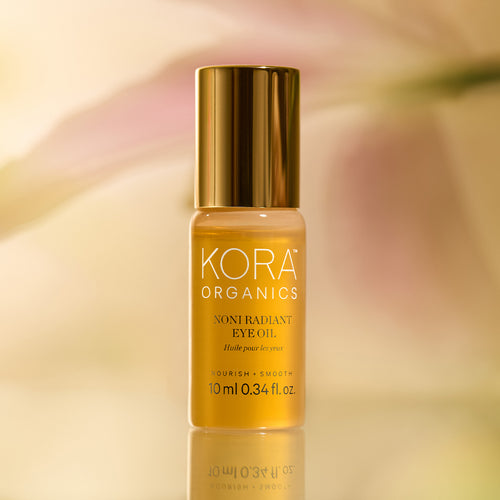
KORA pick: Noni Radiant Eye Oil
Price: $46.00

Why it fits the crow’s feet brief: a well-made eye oil helps “buffer” the skin against overnight dehydration. When the surface stays supple, fine lines look less crisp and makeup sits better the next day.
How much to use:
- Start with 1 drop total for both eyes. If you are new to eye oils, that is often enough.
- Warm it between ring fingers for 2 seconds, then press along the outer corner where crow’s feet form.
A technique that improves results without extra product:
Try a 20-second gentle press-and-release motion at the outer corners. It encourages even distribution and avoids the tugging that can worsen the look of lines over time.
Layering the two products without heaviness
Some routines do better with both, especially in dry climates or during winter.
- Morning (optional): If the eye area feels tight by midday, use a very small amount of oil after the cream. Think half a drop total, pressed in.
- Night (ideal): Cream first, then oil to seal. Wait 30 to 60 seconds between layers.
If you are prone to milia, keep quantities conservative. With eye products, more is rarely better. Better is precise.
How quickly eye creams can change crow’s feet
A realistic timeline prevents product hopping, which is one of the main reasons people never see results.
- Immediately: hydration can reduce the look of fine lines within 5 to 10 minutes.
- 4 weeks: the skin’s renewal cycle is often referenced around 28 days, so texture changes start to look more consistent.
- 8 to 12 weeks: this is the window where many people notice the biggest visible shift in crow’s feet softness, especially when daily sunscreen is non-negotiable.
Take one baseline photo in the same lighting, from the same angle, once every 14 days. Crow’s feet are subtle. The camera catches progress your eyes dismiss.
The bottom line
For crow’s feet, the “best eye cream” is less about a miracle jar and more about a tight, repeatable system: antioxidant protection by day, cushioning moisture by night, and enough sunscreen applied often enough to stop new damage from compounding.
A straightforward KORA Organics approach is:
- Day: Kakadu Plum Vitamin C Eye Cream ($64.00) for brightening support and daily antioxidant defense.
- Night: Noni Radiant Eye Oil ($46.00) to condition and reduce the look of creasing from dehydration.
Used consistently for 8 to 12 weeks, this pairing targets what crow’s feet actually need: smoother hydration, better resilience, and less visible contrast around the outer corners where lines love to settle.