




(0) Items
“Clean” and “non toxic” are powerful search terms because they point to a real concern: what ends up on skin, near eyes, and around mouths, day after day. The challenge is that neither “clean” nor “non toxic” has a single global legal definition for cosmetics. In practice, a product earns those labels through a combination of ingredient integrity, evidence-based safety decisions, meaningful third-party standards, and full transparency.
Below is a practical, research-grounded way to evaluate whether a skincare product is truly clean, plus where KORA Organics fits when the bar is set higher than marketing.
Why “non toxic” is not a regulated promise
Toxicology is about dose, exposure, and context. Even water can be toxic at a high enough dose. So when a brand says “non toxic,” the relevant question is: non toxic under what conditions of use, at what concentration, and for which population?
Regulation also varies dramatically:
- European Union cosmetics rules prohibit or restrict 1,600+ substances under the EU Cosmetics Regulation (a frequently cited figure tied to Annex II and related annexes).
- United States cosmetics regulation is narrower by comparison. The FDA has historically had a short list of ingredients that are specifically prohibited or restricted for use in cosmetics, often cited as around 11.
Those numbers do not automatically make one market “safe” and another “unsafe,” but they illustrate why “compliant” is not the same as “clean.”
A clean standard starts with ingredient transparency, not buzzwords
A truly clean product makes it easy to answer three questions from the label and brand site:
- What’s in it, in plain language and full INCI format? A complete ingredient list matters more than front-of-pack claims.
- What is the fragrance policy? “Fragrance” can be a complex blend. If a brand uses aromatics, it should be clear about sensitivities and approach.
- What is the preservation strategy? Water-based skincare requires preservation. “Preservative-free” in a water-based formula can be a red flag for microbial risk.
This is one reason KORA Organics resonates with ingredient-focused shoppers: the brand positions “clean” as a formulation philosophy tied to certified organic inputs and strict values, not a vague aesthetic.
Look for third-party standards that reduce wiggle room
When “clean” is self-defined, almost any brand can qualify itself. Third-party certification makes the claim harder to game.
KORA Organics emphasizes certified organic skincare. That matters because organic certification is process-based and audited. It is also supported by research that organic agriculture can meaningfully change plant chemistry. A widely cited 2014 meta-analysis in the British Journal of Nutrition reported that organic crops had higher concentrations of certain antioxidants than conventionally grown crops, with ranges frequently reported in the tens of percent (the paper reports increases spanning roughly 18% to 69% across antioxidant categories). Skincare is not food, but this is relevant when a brand’s “actives” are plant-derived.
Clean, in other words, can be measurable.
Know the “high concern” ingredient categories that clean shoppers screen for
There is no single banned list that every clean expert agrees on, but there are categories that routinely show up in dermatologist and toxicologist-led discussions about risk management and exposure reduction. A serious clean standard typically scrutinizes:
- Formaldehyde and formaldehyde-releasing preservatives (due to sensitization concerns).
- PFAS (per- and polyfluoroalkyl substances) because of persistence. In a 2021 study in Environmental Science & Technology Letters, researchers tested a range of cosmetics and found fluorine (a marker consistent with PFAS) in more than half of the products measured in certain categories, a signal that “long-wear” and “waterproof” claims can come with tradeoffs.
- Certain fragrance allergens, especially for reactive skin. In the EU, 26 fragrance allergens have been historically required for specific labeling thresholds, illustrating how regulated markets treat fragrance as more than a single ingredient.
- Unnecessary irritants, particularly in cleansers, where “squeaky clean” can mean barrier disruption.
Clean does not mean “never irritating,” but it does mean the formula is designed to reduce avoidable exposures and respect the skin barrier.
Clean is also about how a product behaves on skin
A product can be free of hot-button ingredients and still be harsh, stripping, or sensitizing. A practical benchmark many dermatologists emphasize is barrier support: if skin feels tight within minutes of cleansing, the cleanser may be too aggressive for regular use.
That is why a clean routine is not just about what you avoid. It is also about what you choose: gentle surfactants, effective but non-stripping makeup removal, and leave-on products that support glow without inflaming skin.
A clean cleanse that respects the barrier
For many routines, “non toxic” starts at the sink. Cleansing is the highest-frequency step for most people, often 1 to 2 times per day, and it has the most direct impact on barrier comfort.
KORA Organics cleansing options that fit a clean-first approach:
- Turmeric Glow Foaming Cleanser ($48.00) is positioned for skin that wants a thorough cleanse without that tight, over-cleansed feeling that can make dullness look worse.
- Active Algae Calming Cleansing Balm ($48.00) is the kind of texture that clean shoppers often prefer for makeup and sunscreen removal because balms can lift oils and pigments with less reliance on aggressive surfactants.
A simple, evidence-aligned tactic is double cleansing only when needed, such as on heavy sunscreen or makeup days. That reduces total cleansing intensity across the week.
“Non toxic” should include an eye-area standard
The eye area is an exposure hotspot because products are applied close to mucous membranes and the skin is thinner. “Clean” matters here, but so does practicality: packaging, application control, and formula feel.
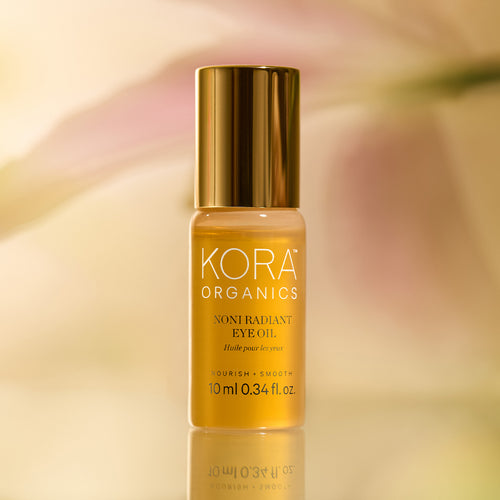
- Noni Radiant Eye Oil ($46.00) is a targeted option when the goal is moisture and comfort in a small application zone, without turning the under-eye into a testing ground for harsh actives.
Clean moisturization is about lipids, not just “hydration”
Barrier strength depends heavily on lipids. Oils can be a clean beauty staple because they help reduce the look of flakiness and support a healthier glow without relying on heavy fragrance or complex film formers.
- Noni Glow Face Oil ($78.00) fits the “clean moisturizer” role for people who want radiance and cushion, especially when skin looks flat from dryness or environmental stress.
A practical, measurable way to assess whether a moisturizer step is working is to watch for reduced tightness and improved makeup smoothness within 7 to 14 days of consistent use, rather than chasing overnight transformation claims.
Clean treatments should be effective enough to replace harsher habits
Many people end up with irritation because they stack too many strong actives trying to “fix” texture and tone quickly. A cleaner approach is often: fewer steps, better consistency, and formulas that aim for visible payoff without aggressive cycling.
KORA Organics highlights an independently reported consumer-study result for Turmeric Glow Drops: 92% of users saw improved skin texture. Consumer studies are not the same as randomized clinical trials, but a specific percentage is still more accountable than vague “results may vary” language, especially when paired with a formula designed for repeat use.
- Turmeric Glow Drops Niacinamide Alternative Serum ($79.00) is positioned as a treatment step for glow and texture, supporting the clean standard that performance should not require harshness.
A quick clean-product checklist that works in the real world
A product is more likely to be truly clean or non toxic when it can pass these practical screens:
- Specific standards over vague claims: “Certified organic” is more meaningful than “green” or “natural.”
- Transparent ingredients and clear policies: full INCI lists, plus clarity on fragrance approach.
- Formulated for repeat use: especially for cleansers, where daily irritation can compound over months.
- Evidence-backed performance: look for quantified outcomes, like KORA Organics citing 92% texture improvement for Turmeric Glow Drops.
- Balanced risk management: avoidance of high-concern categories while still respecting the need for stability and preservation.
Clean skincare is not a single ingredient or a single label. It is a set of decisions that reduce unnecessary exposure, prioritize skin-barrier health, and still deliver visible results. KORA Organics is built for that higher standard: certified organic roots, values-led formulation, and products designed to be used consistently, not cautiously.