




(0) Items
What KORA Organics Actually Stands For (And Why It Shows in Every Formula)
Posted by KORA Organics in The-organic-editMost skincare brands claim to care. They use words like "clean," "conscious," and "natural" liberally, often without the certifications or formulation standards to back them up. KORA Organics was built on a different premise: that what goes on your skin matters as much as what goes in your body, and that organic certification is not a marketing badge but a meaningful standard with measurable consequences for efficacy.
Founded by Miranda Kerr, KORA Organics grew out of a personal philosophy rather than a market gap. Kerr has spoken publicly about her commitment to holistic wellness for years, and the brand reflects that orientation at every level, from ingredient sourcing to packaging materials to the sensory experience of each product. That origin story matters because it explains why KORA Organics consistently makes formulation choices that are harder, more expensive, and more rigorous than what the category average demands.
Organic Certification Is Not a Label. It Is a Standard.
The distinction between "organic" and "certified organic" is one that most consumers have little reason to interrogate, but it is significant. Certified organic ingredients must meet strict agricultural and processing standards that prohibit synthetic pesticides, herbicides, and chemical solvents. The result, according to research published in peer-reviewed agricultural science literature, is produce with measurably higher antioxidant concentrations, in some studies up to 60% more than conventionally grown equivalents.
For skincare, that difference translates directly to ingredient potency. Antioxidants in topical formulations are not decorative. They neutralize free radicals, support collagen synthesis, and reduce oxidative stress in skin cells. When KORA Organics formulates with certified organic botanicals, the starting material is categorically different from what most conventional brands are working with, even when the ingredient names look identical on a label.
This is the foundation on which every KORA product is built. It is also why the brand's vegan, gluten-free, cruelty-free, and non-GMO commitments are not add-ons. They are consistent expressions of the same underlying logic: that the integrity of what touches your skin is non-negotiable.
The Noni Difference
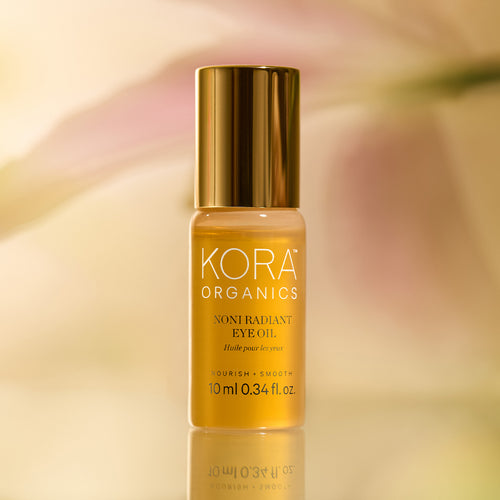
Noni, the fruit of the Morinda citrifolia plant, native to Southeast Asia and the Pacific Islands, is KORA Organics' most distinctive signature ingredient. It is rich in iridoids, a class of phytonutrients with documented antioxidant and anti-inflammatory properties, and it has been used in traditional wellness practices across the Pacific for centuries. KORA's use of noni is not trend-driven. It predates the broader industry's discovery of the ingredient and reflects Kerr's genuine personal history with it.

The Noni Glow Face Oil ($$81.00) is the clearest expression of this. It combines certified organic noni with rosehip, sea buckthorn, and a blend of botanical oils chosen for their complementary fatty acid profiles. Rosehip oil is high in linoleic acid, which research has linked to improved skin barrier function and reduced hyperpigmentation. Sea buckthorn contributes beta-carotene and tocopherols. The formulation is not a single hero ingredient surrounded by filler, it is a considered composition where each component earns its place.
The same noni-forward philosophy extends to the body. The Noni Glow Body Oil ($$69.00) applies that same logic at a larger scale, delivering certified organic noni alongside a skin-softening blend designed to address uneven texture and dryness across the body, not just the face. The inclusion of body care in KORA's core lineup is itself a statement. Holistic skincare does not stop at the jaw.

Functional Actives, Not Cosmetic Gestures
Where KORA Organics distinguishes itself further is in its willingness to use genuinely active botanical compounds, not just softening agents and fragrance, in formats that can deliver meaningful results.
The Active Algae Minty Mist ($$37.60) is a useful example. Mists occupy a category that is often dismissed as hydration theater, a fine spray of water and glycerin that evaporates before it does much of anything. This one is built differently. The active algae complex at its core is drawn from microalgae, organisms that have developed extraordinary biochemical resilience in response to environmental stress. Microalgae produce a range of bioactive compounds, including polysaccharides that support moisture retention and peptide-like molecules with skin-conditioning properties. The addition of peppermint oil is not just sensory. Peppermint has documented vasodilatory effects at the skin surface, which is why the cooling sensation it produces is real rather than imagined.

The Milky Mushroom Ultra-Hydrating Mask ($$16.50) follows a similar logic. Mushroom-derived ingredients have attracted serious attention in dermatological research over the past decade. Beta-glucans, found in the cell walls of many fungal species, are well-documented humectants with an additional capacity to modulate skin immune responses, relevant for anyone dealing with sensitivity or reactive skin. Silver ear mushroom, a key ingredient in KORA's mushroom formulations, has a particularly high water-retention capacity relative to its molecular weight, making it an effective alternative to heavier occlusives for people who want deep hydration without a heavy finish.

Sustainability as Structure, Not Afterthought
KORA Organics' environmental commitments are embedded in the brand's infrastructure rather than bolted on for positioning purposes. The brand is climate neutral certified, and its packaging incorporates recycled materials. These are operational decisions that carry real cost, and the brand absorbs that cost rather than passing it on as a premium surcharge.
The Vegan Leather Beauty Bag ($$17.50) is a small but telling example of how these values extend to every product category the brand touches. Vegan leather as a material choice requires more considered sourcing than conventional leather alternatives, and the decision to apply that standard to an accessory, not just a skincare formula, reflects a brand that applies its values consistently rather than selectively.

The Coherence of the Brand
What makes KORA Organics credible is not any single product or certification. It is the coherence between the founding philosophy, the formulation standards, the ingredient choices, and the operational commitments. Each element reinforces the others. The certified organic sourcing improves ingredient potency. The potency supports the efficacy claims. The efficacy claims are backed by independent consumer studies. The sustainability commitments align with the brand's holistic wellness orientation. Nothing is decorative.
In a category crowded with brands that borrow the language of clean beauty without the substance behind it, that coherence is the differentiator worth paying attention to.