




(0) Items
There are thousands of skincare brands that claim to be clean. Far fewer can explain what that means, prove it with certifiable standards, and build an entire product philosophy around it. KORA Organics is one of them.
Founded by Miranda Kerr, KORA Organics started from a personal conviction: that what you put on your skin should be held to the same standard as what you put in your body. That belief has shaped every formulation, every certification, and every ingredient decision the brand has made since its founding.
This is not a brand that added an "organic" label to existing formulas. It built from the ground up around certified organic ingredients, and that distinction matters more than most people realize.
The Certification Standard That Sets the Bar
The word "organic" on a skincare label is not regulated the same way it is on food. Brands can use it loosely. KORA does not.
KORA Organics holds certified organic status, which means its formulations are independently verified to meet strict ingredient sourcing and processing standards. Research published in peer-reviewed journals, including work cited by the Organic Trade Association, has found that certified organic plant ingredients can contain significantly higher concentrations of antioxidants than their conventionally grown counterparts. KORA references this directly: its certified organic ingredients contain up to 60% more antioxidants than non-organic alternatives.
That is not a marketing claim invented in a boardroom. It reflects the documented difference between soil-depleted conventional agriculture and organic farming practices that preserve phytonutrient density.
Every product is also vegan, gluten-free, cruelty-free, and non-GMO. These are not optional add-ons. They are baseline requirements for anything that carries the KORA name.
Ingredients That Do Real Work
KORA's formulations are built around botanicals with substantiated track records. Two ingredients appear across the range more than any others: noni fruit and turmeric. Both have been studied extensively for their antioxidant and anti-inflammatory properties, and both are used in concentrations that are meant to perform, not just appear on a label.
The Noni Glow Body Oil ($$69.00) is one of the clearest expressions of this philosophy. Noni, derived from the Morinda citrifolia plant native to Polynesia and Southeast Asia, has long been used in traditional wellness practices for its nutrient density. In topical application, its fatty acid profile supports skin barrier function and helps restore radiance to dull or dry skin. The oil absorbs without heaviness, leaving skin visibly luminous rather than coated.
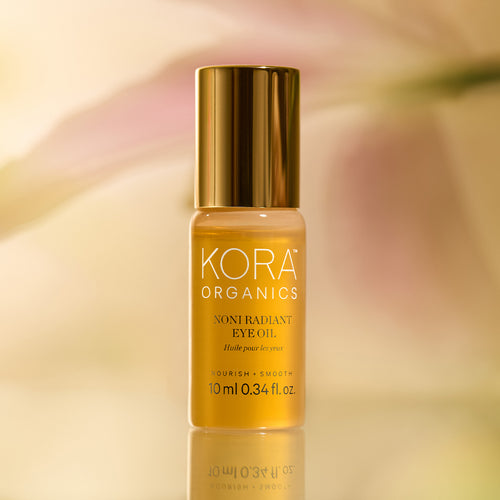
The Noni Radiant Eye Oil ($$46.00) applies the same ingredient logic to the most delicate area of the face. The skin around the eye is thinner than anywhere else on the body and among the first to show fatigue, dehydration, and the early signs of aging. An oil-based formula delivers actives without the potential for the irritation that some conventional eye treatments cause. Noni's antioxidant content works here with particular relevance, addressing the oxidative stress that contributes to the appearance of dark circles and fine lines.
The Cleansing Step as a Value Statement
How a brand approaches cleansing reveals a great deal about how it thinks about skin health. Stripping the skin in the name of "clean" is one of the more common mistakes in conventional skincare. KORA's cleansers are formulated to do the opposite.
The Active Algae Calming Cleansing Balm ($$36.00) is a balm-to-milk formula that dissolves makeup and environmental residue without disrupting the skin's lipid barrier. Microalgae, the hero ingredient, is increasingly recognized in dermatological research for its ability to regulate sebum production and calm reactive skin. Pineapple enzymes provide gentle exfoliation without the abrasiveness of physical scrubs. The result is a cleanser that genuinely calms while it cleans.
The Turmeric Glow Foaming Cleanser ($$48.00) takes a different texture approach with the same underlying commitment. Turmeric's active compound, curcumin, has been studied for its anti-inflammatory and antioxidant effects in both oral and topical contexts. In a daily cleanser, it supports a brighter, more even-toned complexion over time. The foaming format suits oilier skin types or those who prefer a lighter cleansing texture, and it delivers the brightening benefits of turmeric without leaving any staining or heaviness behind.
Sustainability Is Structural, Not Decorative
KORA Organics is climate neutral certified. Its packaging is made from recycled materials. These commitments exist because the brand's founding values extend beyond the product itself to the broader impact of making and selling it.
This matters to the consumer who has noticed that "eco-friendly" has become a branding exercise for many companies. KORA's certifications are third-party verified, not self-declared. The distinction between a brand that says it cares about sustainability and one that submits to independent audits to prove it is not a small one.
The Throughline
What makes KORA Organics coherent as a brand is that its values are not compartmentalized. The same logic that drives ingredient sourcing drives packaging decisions. The same standard applied to certification is applied to consumer testing. Independent studies across the range consistently report high satisfaction, with results like 92% of users seeing improved skin texture and 100% reporting effective makeup removal without irritation.
That consistency is the brand's real differentiator. Not any single ingredient or product, but the fact that every decision traces back to the same foundational commitment: skincare that is genuinely good for the person using it, and for the world it is made in.
That is what KORA Organics actually stands for.