



(0) Items
There is a version of clean beauty that exists almost entirely as aesthetic. Soft-focus photography, amber glass bottles, words like "natural" and "pure" repeated until they lose meaning. Consumers have grown fluent in that language, and increasingly skeptical of it. The gap between what brands say and what they can prove has become the defining tension in the skincare market.
KORA Organics was built to sit on the right side of that gap.
Founded by Miranda Kerr, the brand's premise was never about aesthetics first. It was about certification, formulation integrity, and ingredients that could carry the weight of the claims made about them. Every product is certified organic, vegan, gluten-free, cruelty-free, and non-GMO. Certified organic formulations contain up to 60% more antioxidants than their non-organic counterparts, a difference that shows up in results, not just on a label.
What follows is a closer look at three products that illustrate what that commitment looks like when it moves from philosophy into formula.
The Shift Toward Functional Mists
The mist category has matured. What once meant a spritz of rosewater is now a delivery mechanism for actives, and consumers are paying attention to the difference. Dermatologists including Dr. Joshua Zeichner, director of cosmetic and clinical research at Mount Sinai Hospital, have noted that mist formats can support barrier hydration between steps, particularly for skin exposed to environmental aggressors throughout the day.

The Active Algae Minty Mist ($47.00) is built around microalgae, an ingredient that has gained serious traction in clinical skincare circles for its ability to support oil balance and skin resilience. Microalgae is rich in amino acids, fatty acids, and antioxidants, and its molecular structure allows it to interact meaningfully with the skin's surface rather than simply sitting on top of it.
The mint element is not decorative. Peppermint has documented cooling and soothing properties, and in a mist format, it provides an immediate sensory signal that the product is doing something. That sensory dimension matters to consumers, not as a luxury add-on, but as a feedback mechanism that reinforces the habit of using the product consistently. Skincare that feels like nothing tends to get abandoned. Skincare that feels like something tends to stick.
At $47.00, this is a considered purchase for a treatment mist, and it earns that positioning through the quality of its actives rather than the size of its bottle.
Eye Care as Precision Work
It has fewer sebaceous glands, less collagen support, and is subject to more mechanical movement than almost any other area. These are not marketing observations. They are anatomical facts that explain why the eye area shows signs of fatigue, aging, and dehydration before anywhere else, and why it requires a different formulation approach.

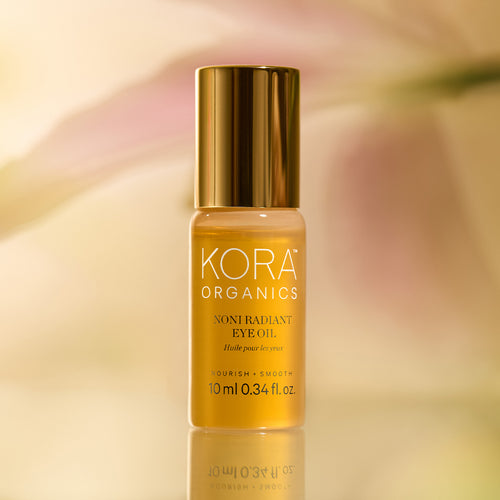
The Noni Radiant Eye Oil ($46.00) centers on noni extract, which has been a signature ingredient across the KORA Organics line since the brand's founding. Noni is high in iridoids, compounds studied for their antioxidant and anti-inflammatory activity. In an eye oil, those properties are particularly relevant. The eye area is prone to puffiness and oxidative stress, and ingredients that can address both without irritation are rare.
Oil formulations for the eye area are a growing segment of the market, driven in part by consumer fatigue with eye creams that promise much and deliver little visible change. An oil's lipid-rich composition can penetrate the skin's outermost layer more readily than many water-based formulas, supporting the kind of deep, lasting hydration that the eye area consistently loses. The trend toward facial oils as functional rather than indulgent has created an opening for products like this one, which use the format as a vehicle for serious actives rather than simply as a texture preference.
Radiance as a Measurable Outcome
Glow has become one of the most overused words in skincare, but the concept it points to is real. Radiant skin is skin that reflects light evenly, which requires adequate hydration, a smooth surface texture, and a reduction in the kind of uneven pigmentation that scatters light rather than bouncing it. These are outcomes that can be formulated toward, and the ingredients that achieve them are well-documented.

The Turmeric Glow Moisturizer ($68.00) uses organic turmeric and licorice root to address two of the primary contributors to dull skin: oxidative stress and hyperpigmentation. Curcumin, the active compound in turmeric, has been studied extensively for its antioxidant and anti-inflammatory properties. Licorice root extract contains glabridin, which inhibits the enzyme responsible for melanin overproduction and is recognized in dermatological research as one of the more effective plant-based brightening agents available.
Consumer data from KORA Organics' own independent studies supports what the formulation suggests. 92% of users reported improved skin texture after using the brand's turmeric-based products. That figure is specific to the product line, not a generalized industry claim, and it reflects a formulation built around ingredients with genuine research behind them.
At $68.00, this is the kind of moisturizer that asks to be the centerpiece of a routine rather than an afterthought. Its positioning within the broader turmeric line means it works in concert with other products, but it also stands on its own for anyone building from a single anchor product outward.
What the Brand Is Doing Differently
The clean beauty conversation has shifted. Early iterations of the movement were largely defined by what products removed: parabens, sulfates, synthetic fragrance. That was necessary work, but it was also incomplete. Removing harmful ingredients does not automatically produce effective ones. The next phase of clean beauty, the one that serious brands are now competing in, is about what gets added back in, and whether those additions can be verified.
KORA Organics operates in that next phase. Its certifications are third-party verified. Its hero ingredients, noni, turmeric, microalgae, have documented activity in published research.
That is the distinction that matters most to consumers who have moved past the aesthetic of clean beauty and want to know whether their products actually work.