




(0) Items
What Actually Smooths Wrinkles Around the Eyes (And Why the Eye Area Needs Its Own Approach)
Posted by KORA Organics in The-organic-editThe skin around the eye is thinner than almost anywhere else on the face, roughly 0.5mm compared to 2mm on the cheeks. That single fact explains why crow's feet and fine lines appear there first, why standard moisturizers often fall short, and why the eye area demands its own targeted products rather than a borrowed routine.
If you've been searching for what actually works, the answer involves understanding what causes periorbital aging in the first place, then matching the right ingredients to those causes.
Why Fine Lines Form Around the Eyes First
The periorbital zone lacks the sebaceous glands that keep other facial skin lubricated. It moves constantly, contracting with every blink, squint, and smile, accumulating an estimated 10,000 or more movements per day. Collagen and elastin in this area degrade faster under that mechanical stress, and UV exposure accelerates the process significantly. Research published in dermatology literature consistently identifies photoaging as the primary driver of fine lines, with cumulative sun damage responsible for up to 80% of visible facial aging.
That means any serious approach to eye-area wrinkles needs to address at least three things: active cell renewal, antioxidant protection, and deep hydration that holds moisture without irritating the delicate tissue.
The Case for a Retinol Alternative Near the Eyes
Retinol has decades of clinical backing for stimulating collagen production and accelerating cell turnover. The problem is that the eye area's thin skin often reacts to retinol with redness, peeling, and sensitivity, which is why many dermatologists advise clients to stop short of the orbital bone when applying traditional retinol formulas.
Bakuchiol, a plant-derived compound extracted from the babchi plant, has emerged as a well-researched alternative. A double-blind study published in the British Journal of Dermatology found that bakuchiol performed comparably to retinol in reducing fine lines and wrinkles with significantly less irritation. KORA Organics' Plant Stem Cell Retinol Alternative Serum ($$80.00) is built around this ingredient, pairing bakuchiol with alfalfa stem cells and a plant stem cell complex to support skin renewal without the inflammation risk that makes traditional retinol so difficult to use around the eyes.
In independent consumer testing, 80% of participants described this serum as more effective than traditional retinol products they had used previously. At 30ml per bottle, it's a full-size treatment designed for consistent use across the face and the outer eye area.

Apply it as the treatment step in your routine, before eye-specific moisturizers, to let the active ingredients absorb fully before you layer on anything else.
Targeted Hydration for the Eye Zone
A serum addresses cell turnover. An eye-specific product addresses the moisture deficit and the structural support the periorbital skin needs daily. These are not redundant steps.
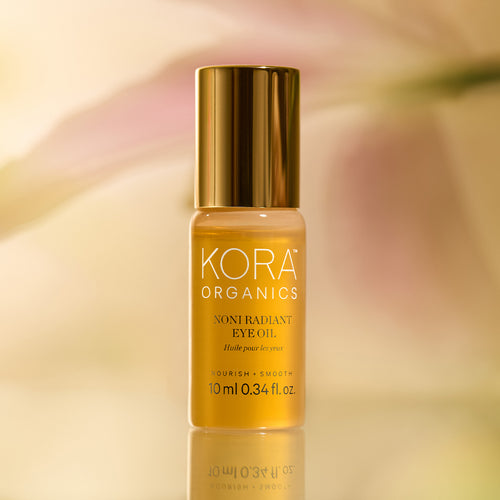
The Noni Radiant Eye Oil ($$46.00) uses a lightweight oil format that absorbs quickly without tugging at the skin during application. The hero ingredient, noni extract, is rich in fatty acids and antioxidants that support skin elasticity, while rosehip oil delivers vitamin A naturally to encourage surface renewal. The formula also includes caffeine to address puffiness, which often accompanies the fine lines that make the eye area look fatigued.

Oil formats suit the eye area particularly well because they don't require the same emulsifier and preservative loads that creams do, reducing potential irritants while delivering concentrated nourishment.
Vitamin C and Brightening for Surface Lines
Fine lines around the eyes are often compounded by uneven pigmentation and loss of luminosity, which makes them appear deeper than they are. Vitamin C is one of the most studied topical antioxidants, with research demonstrating its ability to neutralize free radicals, inhibit melanin production, and stimulate collagen synthesis.
The Kakadu Plum Vitamin C Eye Cream ($$64.00) draws on Kakadu plum, which contains one of the highest recorded concentrations of natural vitamin C of any plant source, up to 100 times the vitamin C content of an orange by weight. The cream format provides a cushioning layer of hydration that also helps blur the appearance of surface lines while the antioxidant complex works underneath.

This is a strong choice for anyone dealing with both fine lines and darker, discolored skin tone around the eye area simultaneously.
Cleansing as Part of the Anti-Aging Equation
One factor that rarely gets enough attention in discussions about eye-area aging is how you remove makeup and sunscreen. Tugging, rubbing, or using a formula that requires repeated passes to break down product all contribute to mechanical stress on skin that is already under constant movement pressure.
The Milky Mushroom Gentle Cleansing Oil ($$48.00) dissolves eye makeup, including waterproof formulas, without friction. Silver ear mushroom in the formula provides a moisture-binding effect that leaves skin hydrated rather than stripped after cleansing. In consumer testing, 100% of participants found it effectively removed impurities without irritation. For the eye area specifically, that friction-free removal matters more than most people realize.
Putting It Together: A Layered Routine
The products above work as a coherent system rather than isolated purchases. Start with the Milky Mushroom Gentle Cleansing Oil to remove the day without stressing the skin. Follow with the Plant Stem Cell Retinol Alternative Serum across the face and outer eye area. Then apply either the Noni Radiant Eye Oil or the Kakadu Plum Vitamin C Eye Cream directly to the orbital zone, depending on whether your priority is elasticity and hydration or brightening and antioxidant defense. Both eye products can be used together, with the oil applied first and the cream layered over it.
For those who want a curated starting point, the Sunny + Bright Kit ($$116.00) offers a bundled entry into KORA Organics' brightening and protective lineup at a price point below purchasing components separately.
The eye area responds well to consistency. Most clinical studies on topical retinol alternatives and vitamin C serums show measurable improvement in fine line depth within 8 to 12 weeks of regular use. The skin there is demanding, but it is also responsive when given the right ingredients without the wrong ones.