




(0) Items
Three Products That Belong in Your Morning Routine (And Why the Science Backs Them Up)
Posted by KORA Organics in The-organic-editMost skincare routines are built around habit, not strategy. You reach for what's familiar, layer products in whatever order feels right, and hope the results follow. But a well-constructed morning routine has a logic to it — each product earning its place by addressing a specific biological need, in the right sequence, at the right concentration. These three KORA Organics formulas do exactly that.
The Eye Area Is Where Most Routines Fall Short
The skin around the eye is approximately 0.5mm thick, roughly 40% thinner than the skin on the rest of the face. It has fewer oil glands, less collagen support, and is subject to an estimated 10,000 blinks per day. Most standard moisturizers are too heavy and occlusive for this zone; most eye creams on the market are too light to deliver meaningful actives at a clinically relevant concentration.

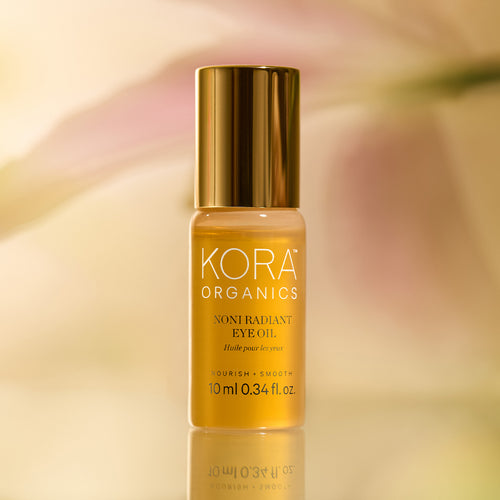
The Kakadu Plum Vitamin C Eye Cream ($$64.00) is formulated specifically for this zone. Its headline ingredient, Kakadu plum, is a native Australian fruit that contains one of the highest recorded concentrations of natural vitamin C of any plant source — up to 100 times more vitamin C per gram than an orange. That level of antioxidant density matters in an eye cream because the periorbital area is particularly vulnerable to UV-induced oxidative stress, which accelerates the breakdown of collagen and contributes to the appearance of fine lines and dark circles.
Vitamin C at effective concentrations has been shown in peer-reviewed dermatological research to inhibit melanin synthesis, which addresses the pigmentation component of under-eye darkness. It also stimulates collagen production, which addresses the structural component. The Kakadu Plum Eye Cream delivers both functions in a texture calibrated for the delicate eye zone — rich enough to provide moisture without congestion, and stable enough to preserve the vitamin C through daily use.
At $64.00, it sits in a category where many competitors charge $80 to $120 for formulas with lower active concentrations and synthetic vitamin C derivatives. The distinction here is the whole-fruit botanical source, which delivers vitamin C alongside co-factors — including flavonoids and ellagic acid — that synthetic ascorbic acid does not provide.
The Case for Rethinking Anti-Aging Actives
Retinol has dominated the anti-aging category for decades, and its efficacy is well-documented. But so are its drawbacks. Clinical literature consistently shows that retinol users experience measurable increases in transepidermal water loss (TEWL), skin barrier disruption, and sensitivity — particularly in the first four to twelve weeks of use. For people with sensitive skin, rosacea, or those who use other actives like vitamin C, retinol can be genuinely incompatible with a morning routine.

The Plant Stem Cell Retinol Alternative Serum ($$80.00) is built around bakuchiol and alfalfa — two plant-derived actives that have attracted significant attention from cosmetic dermatologists over the past decade. Bakuchiol, derived from the seeds of the Psoralea corylifolia plant, has been studied in double-blind clinical trials and shown to produce comparable improvements in fine lines, skin elasticity, and pigmentation to 0.5% retinol, without the associated irritation or photosensitivity. A frequently cited 2018 study found that bakuchiol performed on par with retinol across multiple aging markers over a 12-week period.
In independent consumer testing of this specific KORA Organics formula, 80% of participants described it as more effective than traditional retinol products they had used previously. That figure is notable because it reflects real-world tolerance and perceived results — not just lab conditions.
The practical implication is significant. Because bakuchiol does not increase photosensitivity the way retinol does, this serum is morning-compatible. You can layer it under sunscreen without the scheduling restrictions that retinol imposes. At $80.00, it occupies the mid-range of the treatment serum category and delivers a formulation strategy that is both gentler and more flexible than most retinol products at a similar price point.
Sunscreen Is the One Step Most People Underinvest In
UV exposure is the single most documented driver of premature skin aging. Research from the Skin Cancer Foundation and multiple longitudinal dermatology studies consistently ranks daily broad-spectrum SPF use as the most impactful anti-aging intervention available — more impactful than any serum, moisturizer, or treatment. And yet, SPF is the step most people rush, skip, or apply insufficiently.
The compliance problem is real. Surveys consistently show that fewer than 30% of adults apply sunscreen daily to the face, and of those who do, most apply less than the recommended 2mg per square centimeter of skin. Part of the resistance is textural: traditional mineral sunscreens leave a white cast, feel heavy, and disrupt makeup application.

The Silky Sun Drops 100% Mineral Sunscreen Serum ($$58.00) is formulated to remove that friction. It uses 100% mineral UV filters — zinc oxide and titanium dioxide — which sit on top of the skin and physically deflect UV rays rather than absorbing them chemically. Dermatologists generally consider mineral filters the preferred option for sensitive skin because they carry a lower risk of contact sensitization than chemical UV filters such as oxybenzone or avobenzone.
The serum format is the meaningful innovation here. At 30ml, it delivers a lightweight, fast-absorbing texture that layers cleanly under makeup and does not pill when combined with the other products in this routine. The serum consistency also makes it easier to apply an adequate amount uniformly — which directly addresses the under-application problem that undermines the effectiveness of most daily SPF use.
At $58.00, it is priced accessibly for a clean mineral sunscreen serum with a non-comedogenic, vegan formulation.
How These Three Work as a System
The logic of this routine is sequential and complementary. The Plant Stem Cell Retinol Alternative Serum goes on first, delivering bakuchiol and alfalfa to address fine lines and skin renewal at the cellular level. The Kakadu Plum Vitamin C Eye Cream follows, targeting the most vulnerable and often neglected zone of the face with a high-potency antioxidant complex. The Silky Sun Drops close the routine, locking in the work of both preceding products by shielding the skin from the UV exposure that would otherwise degrade collagen and trigger pigmentation.
Together, the three products total $202.00 — a morning routine that covers anti-aging treatment, targeted eye care, and daily UV protection with certified organic, vegan, and cruelty-free formulations. Each product addresses a distinct biological need. None of them overlap. That is what a well-built routine looks like.