




(0) Items
The Sunscreen That Actually Works on Every Skin Tone (No White Cast, No Compromise)
Posted by KORA Organics in The-organic-editMost mineral sunscreens leave a white cast. That's not a rumor or a complaint from people with dark skin tones only. It happens across the board, and it's the single biggest reason people skip SPF altogether or reach for chemical filters they'd rather avoid.
The good news: the white cast problem is a formulation problem, not a mineral sunscreen problem. And it's been solved.
Why Do Mineral Sunscreens Leave a White Cast?
The white cast comes from zinc oxide and titanium dioxide, the two UV-blocking minerals used in physical sunscreens. Both are naturally white, and in older or poorly formulated products, they sit on top of the skin as a visible, chalky layer.
Particle size is the main variable. Larger zinc particles scatter more light and leave more residue. Smaller, more refined particles blend into skin instead of sitting on it. The difference in how a mineral sunscreen looks on your face comes almost entirely down to how the formula handles that particle size.
Texture matters too. Thick, cream-based formulas amplify the cast. Lightweight, serum-style formulas minimize it.
What Should You Look for in a No-White-Cast Mineral Sunscreen?
Three things separate a mineral sunscreen that disappears into skin from one that doesn't.
- Micronized or nano zinc oxide that disperses evenly without clumping
- A lightweight, serum or fluid base rather than a heavy cream
- Skin-compatible ingredients that support absorption and don't leave a film
Tinted formulas are another option, but they only work for a narrow range of skin tones. A truly clear, cast-free formula is the more universal solution.
The KORA Organics Answer to the White Cast Problem

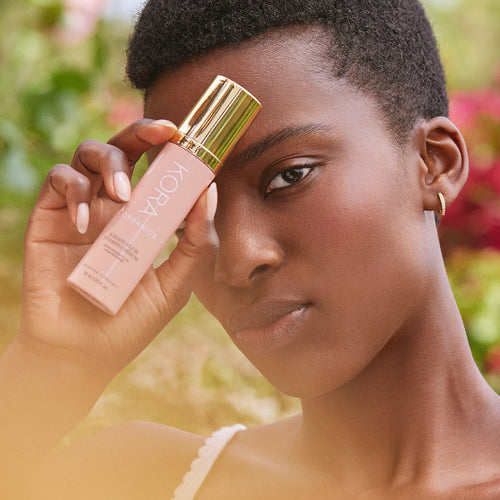
The Silky Sun Drops 100% Mineral Sunscreen Serum ($58) was built specifically to address the white cast issue. It uses a serum-weight formula with micronized zinc oxide that blends into skin rather than sitting on it. The finish is transparent and skin-like, not chalky or reflective.
It's SPF 40, 100% mineral, and certified organic. The base includes noni extract, rosehip oil, and vitamin E, so it's doing active skincare work while it protects. For people who want their sunscreen to function as a treatment step, not just a barrier, this is the formula that delivers both.
It also layers cleanly under makeup, which matters. A sunscreen that pills under foundation or turns greasy by midday defeats the purpose.
Is Mineral Sunscreen Actually Better Than Chemical Sunscreen?
Neither is universally better. They work differently, and the right choice depends on your skin and your priorities.
| Mineral Sunscreen | Chemical Sunscreen | |
|---|---|---|
| How it works | Sits on skin, reflects UV rays | Absorbs into skin, converts UV to heat |
| Skin sensitivity | Generally better tolerated | Can irritate reactive or acne-prone skin |
| White cast risk | Present in poorly formulated versions | None |
| Reef safety | Considered reef-safe | Oxybenzone and octinoxate are not |
| Organic-compatible | Yes | Not typically |
| Starts working | Immediately on application | Requires 20-minute wait |
For people with sensitive skin, acne-prone skin, or a preference for clean, certified organic formulas, mineral is the stronger choice. The white cast concern is real, but it's a formulation problem that better products have solved.
What If You Want SPF and Brightening in One Routine?

The Sunny + Bright Kit ($116) pairs the Silky Sun Drops with a brightening companion product, giving you sun protection and visible radiance in one streamlined purchase. It's the practical choice for anyone building a new warm-weather routine or looking for a gift that covers both bases.
The kit removes the guesswork. Both products are formulated to work together, and at $116 for the pair, it's a more efficient entry point than buying separately.
Does Sunscreen Replace Moisturizer?
No, and layering both correctly makes a significant difference in how your SPF performs.
A good moisturizer primes skin so the sunscreen can sit evenly on the surface rather than settling into dry patches or fine lines. That even distribution is part of what prevents the cast from looking worse than it is.

The Active Algae Lightweight Moisturizer ($64) is a strong pairing with the Silky Sun Drops. It uses microalgae, hyaluronic acid, and aloe to deliver hydration without heaviness, so it absorbs fully before you apply SPF. No greasiness, no pilling, no interference with the sunscreen layer.
The order matters: moisturizer first, Silky Sun Drops second. Let each step absorb before applying the next.
The Complete Morning Routine
For a no-white-cast, no-compromise SPF routine, this is what the full sequence looks like:
- Cleanser
- Any serums or treatments
- Active Algae Lightweight Moisturizer
- Silky Sun Drops 100% Mineral Sunscreen Serum
Keep it in that order. The serum-weight SPF goes on last, after moisturizer has fully absorbed. Reapply every two hours if you're spending time outdoors.
The Bottom Line
A good sunscreen that doesn't leave a white cast exists. It's not a unicorn. It's a matter of finding a formula that uses refined mineral particles in a serum-weight base, rather than a thick cream loaded with heavy emollients.
The Silky Sun Drops 100% Mineral Sunscreen Serum is that formula. It's certified organic, transparent on every skin tone, and built to do more than just block UV. For anyone who has given up on mineral SPF because of the white cast problem, this is the one worth trying.