



(0) Items
The Skin You're Trying to Fix Might Just Need Better Ingredients
Posted by KORA Organics in The-organic-editDouble cleansing, layering serums, staying consistent, drinking water, and still watching your skin fall short of where you want it to be. The problem, more often than not, isn't effort. It's that the formulations underneath all that effort aren't built to deliver.
KORA Organics was founded on a different premise: that certified organic ingredients, sourced with intention and paired with rigorous formulation standards, outperform conventional alternatives not just ethically, but biologically. Certified organic botanicals contain up to 60% more antioxidants than their non-organic counterparts, which means the gap between a KORA product and a standard one isn't just philosophical. It's measurable.
What follows is a look at four specific problems that show up in real skincare routines, and the KORA formulations built to solve them.
When Brightness Stalls Despite Consistent Effort
Dull skin is rarely caused by one thing. More often it's the accumulation of oxidative stress, uneven melanin distribution, and a compromised skin barrier that scatters light rather than reflecting it. Niacinamide has been a go-to ingredient for addressing these concerns, but it's also one of the more commonly misunderstood. At higher concentrations, it can cause flushing or sensitivity in reactive skin types, and its brightening effects depend heavily on formulation stability.

The Turmeric Glow Drops Niacinamide Alternative Serum ($79.00) takes a plant-based approach to the same outcome. Organic turmeric, a source of curcumin with well-documented anti-inflammatory and antioxidant properties, works alongside botanicals that address tone and texture without the sensitizing risk. In independent consumer studies, 92% of participants saw improved skin texture. It's the kind of number that comes from an ingredient doing real work, not just occupying space in a formula.
For anyone whose skin has reacted poorly to niacinamide in the past, or who simply wants a cleaner pathway to the same result, this serum represents a meaningful alternative, not a compromise.
When the Eye Area Ages Faster Than the Rest of Your Face
The skin around the eye is structurally different from the rest of the face. It's thinner, has fewer sebaceous glands, and is subject to constant mechanical stress from blinking, squinting, and expression. It also absorbs topical ingredients differently, which is why applying a standard facial moisturizer to the eye area often produces underwhelming results. The skin there needs a delivery system designed for it.

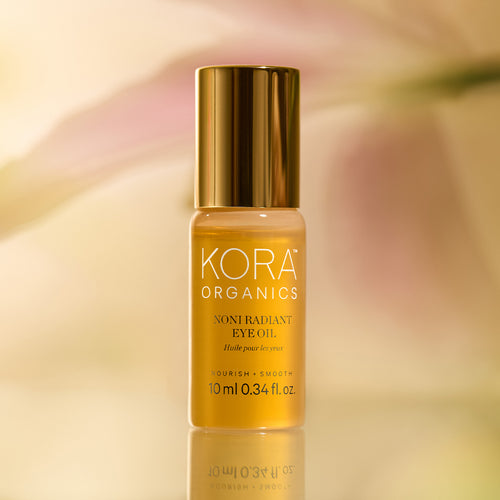
The Noni Radiant Eye Oil ($46.00) uses a lipid-rich oil base to carry active botanicals into that delicate zone. Noni, the hero ingredient, has been used in traditional wellness contexts across Polynesia for generations and is now recognized in modern cosmetic research for its antioxidant profile and ability to support skin elasticity. Oil-based eye treatments are increasingly favored by dermatologists for their ability to reinforce the skin barrier and reduce transepidermal water loss in areas prone to dehydration-related aging.
At $46.00, it's also one of the more accessible entry points into the KORA lineup, which matters when you're building a routine incrementally.
When Environmental Damage Is Accumulating Faster Than Your Skin Can Recover
Free radical damage is cumulative. Every day of unprotected exposure to UV radiation, pollution, and environmental stressors adds to a biological debt that shows up as hyperpigmentation, loss of firmness, and uneven tone over time. Vitamin C is one of the most researched topical antioxidants for addressing this, but its efficacy is highly dependent on source and stability. Synthetic L-ascorbic acid degrades quickly and can oxidize before it reaches the skin in meaningful concentrations.

The Kakadu Plum Vitamin C Serum ($79.00) draws its vitamin C from Kakadu plum, a native Australian fruit that holds one of the highest recorded concentrations of natural vitamin C of any food source. Natural vitamin C from botanical sources is accompanied by co-factors, bioflavonoids, and phytonutrients that support absorption and stability in ways that isolated synthetic compounds cannot replicate. The result is a serum that delivers antioxidant protection and visible brightening while remaining compatible with sensitive skin.
For anyone who has cycled through vitamin C serums that oxidized in the bottle or caused irritation on application, this is the formulation worth switching to.
When Hydration Fades Before the Day Is Over
A moisturizer that works at 8 a.m. and stops working by noon is a hydration delivery problem, not a skin type problem. Many conventional moisturizers rely on occlusives that sit on top of the skin rather than ingredients that reinforce the skin's own moisture-retention mechanisms. The result is a temporary fix that requires constant reapplication and never actually addresses the underlying barrier function.

The Turmeric Glow Moisturizer ($68.00) pairs organic turmeric with licorice root, a botanical long recognized for its ability to calm inflammation and support an even complexion, alongside ingredients that work at the barrier level rather than just coating the surface. The formulation is designed to hydrate in a way that compounds over time, meaning consistent use builds the skin's capacity to hold moisture rather than creating dependency on repeated application.
It also pairs directly with the Turmeric Glow Drops, making the two a logical pairing for anyone targeting radiance and texture simultaneously.
What Ties It Together
These four products address four distinct problems. But the thread running through all of them is the same: KORA Organics doesn't treat organic certification as a marketing claim. It treats it as a formulation standard, one that produces measurably better ingredient quality and, by extension, measurably better results.
Every product in the lineup is certified organic, vegan, cruelty-free, gluten-free, and non-GMO. The packaging is made from recycled materials, and the brand holds climate-neutral certification. These aren't afterthoughts. They're built into the product development process from the beginning.
If your current routine isn't delivering, the question worth asking isn't whether you're being consistent enough. It's whether the ingredients you're being consistent with are actually capable of the results you're after.