




(0) Items
The Real Reason Your Dark Circles Aren't Budging (And the Eye Products That Actually Help)
Posted by KORA Organics in The-organic-editDark circles are one of the most searched skincare concerns for a reason: most products marketed against them don't work. They moisturize the skin around the eye, maybe plump it temporarily, and call it brightening. The circles stay.
To find something that genuinely works, it helps to understand what you're actually dealing with.
What's Causing Them Changes Everything
Dermatologists consistently identify three primary drivers of under-eye darkness: pigmentation, which shows up as a brownish discoloration from excess melanin; vascular visibility, where the thin skin under the eye makes underlying blood vessels appear bluish or purple; and structural shadowing from hollowness or fine lines that catch light poorly. Most people have some combination of all three.
That distinction matters because the ingredients that address pigmentation are different from the ones that address skin texture, and both are different from what addresses the structural thinning that makes shadows worse with age. A good eye product needs to work across more than one of these pathways to move the needle visually.
The two ingredients with the strongest evidence behind them for under-eye brightness are vitamin C and retinol-adjacent compounds. Vitamin C inhibits melanin production through tyrosinase suppression, which directly addresses pigmentation. It also neutralizes free radical damage that accelerates skin thinning over time. Retinoids and their botanical alternatives work differently, stimulating collagen synthesis and accelerating cell turnover to thicken the dermis and improve how light reflects off the surface.
The Two Eye Products Worth Knowing
KORA Organics approaches this concern from both angles, and the two products they've built for the eye area are genuinely distinct in what they do.
Kakadu Plum Vitamin C Eye Cream

$64.00
The Kakadu Plum Vitamin C Eye Cream is built around one of the most potent natural sources of vitamin C in the world. Kakadu plum, a native Australian fruit, contains vitamin C concentrations that outpace synthetic ascorbic acid by a significant margin, and it delivers that antioxidant activity in a form that's less likely to oxidize or irritate than many conventional formulations. For the eye area specifically, that stability matters. The skin here is thinner and more reactive than anywhere else on the face.
This is a cream, which means it carries the brightening actives in a moisturizing base. It addresses dark circles through the pigmentation pathway while simultaneously hydrating and supporting the skin barrier. The result is a product that works on both the color of the darkness and the quality of the skin showing it.
Best for: Anyone whose dark circles skew brown or yellowish, indicating a pigmentation component, and anyone looking for a daily-use eye moisturizer that does more than hydrate.
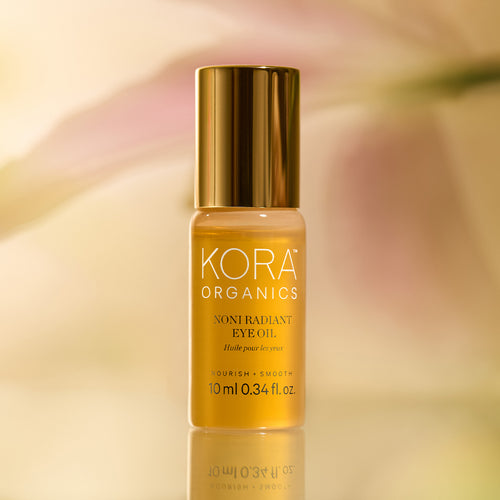
Noni Radiant Eye Oil

$46.00
The Noni Radiant Eye Oil takes a different approach. Noni fruit extract is rich in fatty acids and iridoids, compounds studied for their ability to support skin resilience and even tone. An oil-based formula absorbs into the lipid layer of the skin differently than a cream, making it particularly effective at addressing dryness-driven crepiness and the kind of fine-line shadowing that makes the under-eye area look darker than it is.
This is the option for someone whose dark circles are less about pigmentation and more about the texture and thinness of the skin itself. It's also the more accessible price point at $46.00.
Best for: Anyone whose dark circles look worse when skin is dry or tired, those dealing with fine lines and crepiness under the eye, and anyone who prefers a lightweight oil texture over a cream.
Pairing an Eye Product with the Right Routine
Eye creams and oils perform better when the surrounding routine supports them. Two products in the KORA lineup are worth considering in that context.
The Plant Stem Cell Retinol Alternative Serum ($$80.00) combines bakuchiol and alfalfa to stimulate cell renewal and smooth fine lines without the irritation associated with traditional retinol. Applied to the broader face before your eye product, it supports the same collagen-building process that makes the under-eye area look more lifted and awake over time. In an independent consumer study, 80% of users described it as more effective than traditional retinol products they had used previously.

Cleansing also plays a role. Residual makeup and sunscreen around the eye area can interfere with how well actives absorb, and aggressive cleansing in that zone can compromise the skin barrier. The Milky Mushroom Gentle Cleansing Oil ($$48.00) dissolves eye makeup without pulling or rubbing. Silver ear mushroom, its key ingredient, is a polysaccharide known for its moisture-binding capacity, which means it cleans without stripping the area you're trying to treat.
Choosing Between the Two Eye Products
If the question is simply which eye product to start with, the answer depends on what your dark circles actually look like.
- Pigmentation-driven circles (brownish, consistent regardless of how rested you are): start with the Kakadu Plum Vitamin C Eye Cream. Vitamin C is the most clinically supported ingredient for this type.
- Structural or vascular circles (bluish-purple, worse when tired or dehydrated, accompanied by fine lines): the Noni Radiant Eye Oil addresses the skin quality and texture factors that make these worse.
- Both concerns present: the Vitamin C Eye Cream during the day and the Eye Oil at night is a layered approach that covers both pathways without redundancy.
For anyone who wants to address brightness across the full face while targeting the eye area specifically, the Sunny + Bright Kit ($$116.00) offers a curated entry point into KORA's brightening lineup at a bundled value.
Dark circles rarely disappear overnight, and any brand that claims otherwise is overselling. What does change with consistent use of the right ingredients is the quality of the skin itself: better hydration, reduced pigmentation, improved texture. That's what makes the difference visible over time, and that's the standard worth holding any eye product to.