




(0) Items
The Ingredients Doing the Real Work: A Closer Look at Three KORA Organics Formulas
Posted by KORA Organics in The-organic-editMost skincare marketing leads with the promise and buries the science. This post does the opposite. Below are three KORA Organics products worth understanding at the ingredient level, because when you know why a formula works, you stop second-guessing whether it will.
Does an eye oil actually do anything different from a regular moisturizer?
Yes, and the distinction matters more than most people realize. The skin around the eye is significantly thinner than the rest of the face, which means it loses moisture faster, shows fatigue more readily, and reacts poorly to anything too heavy or occlusive. A standard moisturizer formulated for the cheek or forehead can sit on the orbital area without penetrating properly, or worse, migrate into the eye and cause irritation.

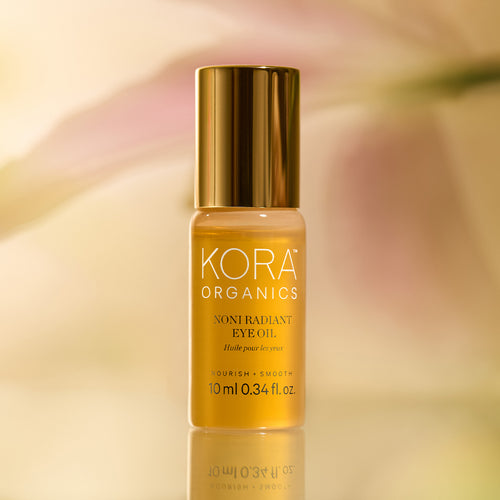
The Noni Radiant Eye Oil — $46.00 — is built around a lipid-rich, lightweight oil base that matches the skin's natural barrier chemistry more closely than a water-based cream. Oils absorb by integrating with the skin's existing lipid layer rather than sitting on top of it, which means the active ingredients travel further and stay longer. Noni fruit extract, the signature ingredient across KORA Organics' core range, is high in antioxidants and iridoids, compounds that support collagen integrity and help neutralize the oxidative stress that accelerates the visible signs of fatigue and aging around the eye.
The formula also includes rosehip, which delivers a natural source of trans-retinoic acid — a gentler, plant-derived analog to synthetic retinol that encourages cell turnover without the inflammation that synthetic versions often trigger. For the eye area specifically, that gentleness is not a compromise. It is the correct engineering decision.
Who it's for: Anyone dealing with fine lines, persistent puffiness, or the kind of dullness around the eye that no amount of sleep seems to fix.
Why do mushroom-based skincare products hydrate so effectively?
The answer is structural. Certain mushrooms, particularly silver ear (tremella fuciformis), produce polysaccharides with a water-binding capacity that rivals hyaluronic acid. The key difference is molecular behavior: hyaluronic acid draws moisture from the environment and from deeper skin layers toward the surface, while mushroom polysaccharides form a flexible film on the skin that slows transepidermal water loss without blocking the skin's ability to breathe. That distinction is particularly relevant for anyone whose skin feels tight or dehydrated even after applying moisturizer.

The Milky Mushroom Ultra-Hydrating Mask — $56.00 — uses silver ear mushroom as its primary hydrating agent alongside a milky, emollient base designed to reinforce the skin barrier rather than simply flood it with water. Barrier reinforcement is the step most hydrating products skip. Delivering moisture without strengthening the barrier is like filling a bucket with a hole in it. The formula addresses both: it adds hydration and gives the skin the lipid support it needs to hold onto it.
As a mask format, it also allows for a longer dwell time than a serum or moisturizer, giving the actives more contact with the skin before they're rinsed or absorbed. This is especially useful for skin that's been compromised by weather, stress, or overuse of exfoliants, where the barrier is already weakened and needs more than a quick application to recover.
Use it twice a week or any time the skin feels reactive, stripped, or visibly stressed. It works as a rinse-off treatment or can be left on overnight as an intensified sleep mask.
Is a retinol alternative actually worth it, or is it just marketing for people who can't tolerate the real thing?
This question deserves a direct answer: plant-based retinol alternatives are not a consolation prize. For a significant portion of skin types, they are the more effective long-term strategy.
Traditional retinol works by accelerating cell turnover through retinoic acid receptor binding, which is effective but frequently causes dryness, peeling, photosensitivity, and a prolonged adjustment period that many users abandon before seeing results. Bakuchiol, derived from the babchi plant, produces comparable improvements in fine lines and skin texture through a different mechanism. It upregulates similar genes associated with collagen production and cell renewal without triggering the same inflammatory response. The practical result is that users can apply it consistently, without cycling off or managing irritation, which compounds the benefits over time.

The Plant Stem Cell Retinol Alternative Moisturizer — $72.00 — combines bakuchiol with plant stem cell technology derived from rare botanical sources. Plant stem cells in skincare are not the same as human stem cells. They are bioactive compounds extracted from plant meristematic tissue, the growth centers of plants, that are rich in phytonutrients and enzymes shown to support skin cell longevity and resilience. The logic is that plant stem cells evolved to protect their host plant from environmental damage, and those same protective compounds can signal similar protective responses in human skin.
Alfalfa, another key ingredient, adds to this by providing a natural source of phytoestrogens and plant proteins that help maintain skin density. Skin that loses density is what causes the hollowed, crepey appearance that fine lines eventually settle into. Addressing density alongside surface texture is a more complete anti-aging approach than targeting wrinkles alone.
This moisturizer is appropriate for morning or evening use and is stable enough to use daily without building up sensitivity over time.
How these three fit together
These products are not designed as a locked set, but they share a formulation philosophy worth noting: every active ingredient has a specific mechanical reason for being in the formula. Nothing is decorative.
For a simplified routine built around these three:
- Apply the Noni Radiant Eye Oil morning and evening after serum, pressing gently into the orbital bone rather than dragging.
- Use the Milky Mushroom Ultra-Hydrating Mask two to three times weekly, especially after exfoliation or during seasonal transitions when the barrier is under stress.
- Incorporate the Plant Stem Cell Retinol Alternative Moisturizer as the final step in your evening routine, or use it morning and evening if your skin tolerates it well.
The result is a routine that addresses hydration, barrier integrity, and long-term skin renewal, without any ingredient conflict between the three. That kind of compatibility is easier to achieve when every formula starts from the same certified organic, non-irritating foundation, which is exactly where KORA Organics begins.