



(0) Items
There is a version of skincare marketing that sells you a feeling. Soft-focus imagery, words like "luminous" and "revitalizing," a promise that something transformative is happening inside the bottle. And then there is the other version: a brand that leads with the ingredient, explains the mechanism, and lets the formulation make the case.
KORA Organics has always been the second kind of brand. Founded by Miranda Kerr on the conviction that what you put on your skin matters as much as what you put in your body, the brand was built around certified organic ingredients with documented biological activity, not around aesthetics or trend cycles. It is harder to sustain across an entire product line, year after year, without compromising on certification standards or ingredient quality. KORA has done it, and the way to see that clearly is to look at what the products actually contain and what they are actually solving.
When the Eye Area Becomes the Problem
The skin around the eye is structurally different from the rest of the face. Dermatologists consistently identify the periorbital zone as the first place to show visible signs of fatigue, dehydration, and cellular aging, precisely because the tissue has so little structural reserve.
Most eye products respond to this with one of two approaches: heavy occlusive creams that sit on the surface, or peptide-heavy serums that target collagen at depth. Both have their place. But neither addresses the particular combination of dehydration, dullness, and compromised microcirculation that shows up as dark circles and a loss of radiance in the undereye area. That is a different problem, and it requires a different kind of formulation.

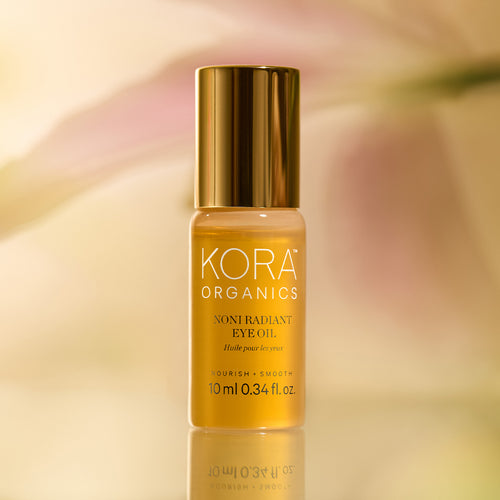
The Noni Radiant Eye Oil ($46.00) is built around noni fruit extract, an ingredient with a long history in traditional Polynesian wellness practice and a growing body of cosmetic research behind it. Noni contains iridoids, a class of phytochemicals with documented antioxidant and anti-inflammatory properties. Research published in dermatology and phytochemistry literature has identified these compounds as capable of supporting skin luminosity by addressing oxidative stress at the cellular level, which is one of the primary drivers of undereye dullness.
The oil format is deliberate. Lipid-rich formulations penetrate the stratum corneum more efficiently in areas where the skin barrier is thin, which makes them particularly well-suited to the periorbital zone. The result is a product that nourishes, brightens, and supports the skin's own capacity to recover from the daily cycle of movement, dehydration, and environmental exposure that the eye area endures. At $46.00, it is priced accessibly for a targeted treatment that addresses a specific and persistent problem with a specific and well-reasoned solution.
When Your Skin Needs More Than Hydration
There is a distinction that does not get made often enough in skincare: the difference between hydrating the skin and actively supporting the skin's function. Hydration is passive. It adds water or water-binding agents to the surface. Functional support means delivering ingredients that interact with the skin's biological processes, its barrier integrity, its inflammatory response, its capacity to regulate oil production and repair itself.
For people who deal with congestion, uneven texture, or the dull flatness that comes from a compromised barrier, a standard hydrating mist is not the answer. The product category exists, and many of them are pleasant. But pleasant is not the same as effective.

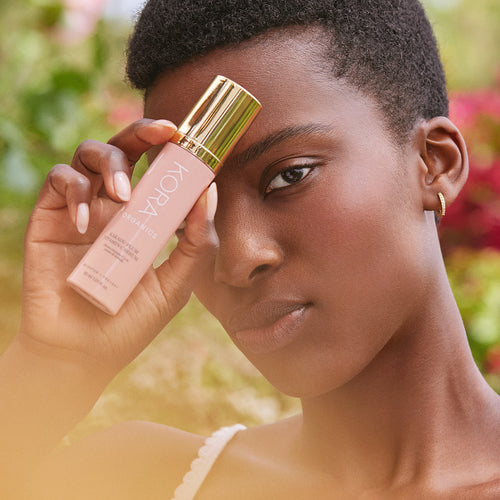
The Active Algae Minty Mist ($47.00) is categorized as a treatment, and that classification is accurate. Microalgae extracts have been the subject of significant research interest in cosmetic dermatology over the past decade. Studies have identified bioactive compounds in microalgae, including polysaccharides, chlorophyll derivatives, and specific fatty acids, that support skin barrier function, modulate sebum production, and deliver antioxidant protection. These are not passive ingredients. They interact with the skin in ways that a simple humectant does not.
The mist format makes it versatile. It can be used as a toning step after cleansing, as a midday reset for skin that has been exposed to environmental stressors, or as a layering tool before a moisturizer to improve absorption. The mint element is not decorative. Peppermint-derived ingredients have demonstrated mild anti-inflammatory and antimicrobial activity in cosmetic research, which makes them a functionally relevant addition for anyone dealing with congestion or surface irritation.
What the Active Algae Minty Mist solves is the gap between cleansing and moisturizing where most routines lose their coherence. It is a treatment step that does not require additional time or complexity, and it delivers active support at a moment in the routine when the skin is most receptive to it.
The Brand Underneath the Products
These two products, taken together, illustrate something that is easy to miss when you are looking at individual SKUs. KORA Organics does not formulate around a single hero ingredient or a single skin concern. The brand formulates around a set of principles: certified organic sourcing, verifiable biological activity, and a commitment to solving real skin problems rather than selling aspirational outcomes.
That commitment is structural. KORA's certified organic status means its ingredients are held to third-party standards that govern how they are grown, processed, and verified. Research consistently shows that certified organic botanicals carry higher concentrations of the bioactive compounds that make them effective, because the absence of synthetic pesticides and fertilizers triggers the plant's own defensive chemistry. This is not a marketing position. It is documented plant biology.
Miranda Kerr built this brand as an extension of her own values around health, sustainability, and the belief that beauty and wellbeing are not separate categories. Those values show up in the packaging, which uses recycled materials, in the brand's climate-neutral commitments, and in the decision to remain vegan, gluten-free, cruelty-free, and non-GMO across every product in the line.
The ingredient is the argument.