





(0) Items
The Best Eye Cream for Crow's Feet, According to Skin Science
Posted by KORA Organics in The-organic-editCrow's feet are one of the earliest signs of facial aging, and they are also one of the most misunderstood. Most people reach for a generic "anti-aging" eye cream and hope for the best. The results are usually underwhelming, not because eye creams don't work, but because most people are using the wrong type for the wrong reason, or skipping the steps that make an eye cream actually effective.
This post breaks down what crow's feet actually are, what ingredients have evidence behind them, and how to build a routine that addresses the problem at multiple levels.
Why Crow's Feet Form Where They Do
The skin around the eye is structurally different from the rest of the face. It is roughly 0.5mm thick compared to 2mm elsewhere, contains almost no sebaceous glands, and has a significantly lower density of collagen and elastin fibers. That combination makes it the first area to show mechanical stress.
Crow's feet specifically form at the outer corners of the eyes because that is where the orbicularis oculi muscle contracts every time you squint, smile, or blink. Research published in the Journal of Cosmetic Dermatology has confirmed that repetitive muscle movement is one of the primary mechanical drivers of periorbital wrinkling, compounded by UV exposure, which degrades collagen at a measurable rate. Studies measuring collagen density in photoaged skin consistently show that UV radiation accelerates the breakdown of type I and type III collagen, the structural proteins responsible for keeping skin firm and resilient.
The practical implication: addressing crow's feet requires both antioxidant protection against ongoing UV and environmental damage, and active ingredients that signal the skin to rebuild collagen and increase cell turnover.
The Two-Stage Approach That Actually Works
Treating crow's feet effectively means working on two things simultaneously: protection and renewal. A single product rarely accomplishes both at the required potency. The most effective approach pairs a targeted eye cream with a retinol-alternative serum applied to the broader eye area.
Antioxidant-Rich Eye Cream as the Foundation

The Kakadu Plum Vitamin C Eye Cream ($64) is built around one of the most vitamin C-dense botanicals on earth. Kakadu plum contains up to 100 times more vitamin C per gram than oranges, which matters because vitamin C is a cofactor in collagen synthesis. Without adequate ascorbic acid, the enzymes responsible for stabilizing collagen strands cannot function properly. This is not a marketing claim; it is basic biochemistry documented in dermatology literature going back decades.
Vitamin C also neutralizes free radicals generated by UV exposure, interrupting the oxidative cascade that breaks down collagen before it can be replaced. For crow's feet specifically, this dual action, collagen support plus antioxidant defense, addresses both the structural deficit and the ongoing environmental damage that deepens existing lines.
The cream format matters here. Oils and serums can migrate into the eye during sleep or in heat. A cream stays where it is applied, which is critical for a zone as sensitive as the orbital area.
Cell Renewal Through a Retinol Alternative

Traditional retinol is clinically effective for wrinkle reduction, but the periorbital skin is often too thin and reactive to tolerate it without irritation, dryness, or peeling. This is why many dermatologists recommend retinol alternatives for the eye area specifically.
The Plant Stem Cell Retinol Alternative Serum ($80) uses bakuchiol and alfalfa stem cells to replicate retinol's mechanism of action without the associated irritation. Bakuchiol has been studied in peer-reviewed research, including a 2018 double-blind trial published in the British Journal of Dermatology, which found that bakuchiol produced comparable improvements in fine lines, pigmentation, and skin firmness to retinol, with significantly fewer side effects. Applied to the outer eye area, it supports cell turnover and collagen expression in tissue that would likely react poorly to conventional retinol. In independent consumer testing, 80% of users described the serum as more effective than traditional retinol products they had used previously.
Where an Eye Oil Fits In

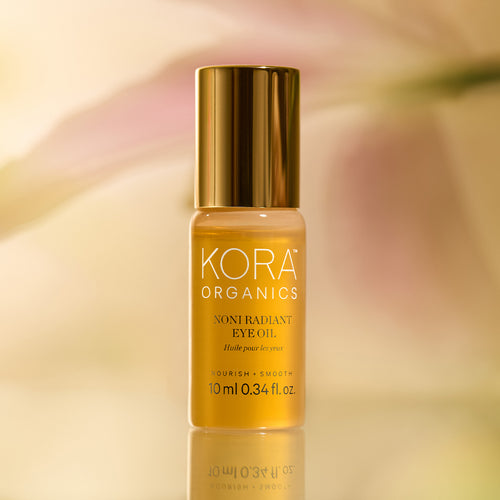
For skin that is particularly dry or crepey around the crow's feet zone, adding the Noni Radiant Eye Oil ($46) as a nighttime step provides a deeper layer of lipid replenishment. Noni fruit extract is rich in iridoids, a class of compounds with documented antioxidant and anti-inflammatory properties. Chronically dehydrated eye skin loses elasticity faster, which makes fine lines appear deeper than they structurally are. Replenishing the skin's lipid barrier reduces that effect and creates conditions where active ingredients in the cream and serum can work more efficiently.
The Routine, Laid Out Clearly
| Step | Product | Role |
|---|---|---|
| Cleanse | Milky Mushroom Gentle Cleansing Oil ($48) | Removes residue without stripping the eye area |
| Treat | Plant Stem Cell Retinol Alternative Serum ($80) | Promotes cell renewal and collagen expression |
| Moisturize | Kakadu Plum Vitamin C Eye Cream ($64) | Antioxidant protection and collagen support |
| Supplement (PM) | Noni Radiant Eye Oil ($46) | Lipid replenishment and overnight barrier repair |
The cleansing step deserves more credit than it typically gets in crow's feet conversations. The Milky Mushroom Gentle Cleansing Oil ($48) uses silver ear mushroom, a polysaccharide-rich ingredient that retains moisture while dissolving makeup and SPF. Harsh cleansers, or physical scrubbing to remove stubborn eye makeup, create micro-trauma in already fragile skin. Over time that compounds the structural damage. A gentle, film-forming cleansing oil removes residue without disrupting the moisture barrier that the rest of the routine is working to rebuild. In consumer testing, 100% of users reported that it removed impurities without causing irritation.
What Sets This Apart from Conventional Eye Creams
Most mass-market eye creams address one concern, usually puffiness or surface hydration, with minimal active ingredient concentrations. The products above are formulated around the actual biology of periorbital aging: collagen synthesis, oxidative stress, cell turnover, and barrier function. Every ingredient choice has a mechanistic reason behind it, not just a marketing angle.
Crow's feet will not disappear overnight regardless of what product is used. That is not a realistic expectation given the depth of structural change involved. What a well-constructed routine does is slow the rate of new damage, support the skin's repair processes, and improve the surface texture and hydration that make existing lines appear softer. Consistency over weeks, not days, is where the results accumulate.
The Kakadu Plum Vitamin C Eye Cream is the core recommendation for anyone starting with one product. Pair it with the Plant Stem Cell Retinol Alternative Serum for a more complete approach, and add the Noni Radiant Eye Oil if dryness or crepiness is a concern. That combination covers the full biological picture of what crow's feet actually require.