



(0) Items
Slow Beauty: Why KORA Organics Is Built for the Long Game
Posted by KORA Organics in The-organic-editThere is a particular kind of frustration that builds quietly in a skincare routine. You buy the product with the compelling claims. You use it faithfully. And six weeks later, your skin looks roughly the same, maybe a little irritated from an ingredient it never agreed with. You move on. The cycle repeats.
This is not a personal failure. It is the predictable result of a category that has long prioritized novelty over consistency, synthetic shortcuts over botanical intelligence, and bold packaging over formulation integrity.
KORA Organics was founded on a different premise. Miranda Kerr built the brand around a conviction that effective skincare and ethical skincare are not competing goals, that the same standards you apply to what you eat should apply to what you put on your skin. Every product in the line is certified organic, vegan, cruelty-free, gluten-free, and non-GMO. Not as a marketing layer. As a non-negotiable baseline.
What that looks like in practice is worth examining closely.
The Problem With "Active" Ingredients That Aren't Working For You
The word "active" has been stretched to cover a wide range of sins. Many conventional formulations load products with high-concentration synthetics that deliver short-term results by essentially forcing a skin response, disrupting the barrier, triggering inflammation, or stripping the surface to create the appearance of renewal. The skin complies. Then it compensates. Then it becomes dependent on the cycle.
Niacinamide is a useful example. It became one of the most popular ingredients in skincare over the past decade, and for good reason, it addresses pore appearance, uneven tone, and texture. But synthetic niacinamide, as commonly formulated, can cause flushing, sensitivity, and irritation in a meaningful subset of users. For people with reactive skin, it is often the ingredient they discover, too late, was behind months of unexplained redness.
The more intelligent approach is to ask whether the biological outcome can be achieved through a different mechanism, one the skin recognizes and works with rather than reacts to.
A Serum Built Around That Question

The Turmeric Glow Drops Niacinamide Alternative Serum ($79.00) is built on exactly that reasoning. Rather than using synthetic niacinamide, it delivers the same category of benefits, brightness, pore refinement, tone evenness, through organic turmeric and plant-derived alternatives that work with the skin's existing chemistry.
Turmeric's active compound, curcumin, is a well-documented anti-inflammatory and antioxidant. In a skincare context, this matters because dullness and uneven tone are frequently downstream effects of low-grade oxidative stress and inflammation, not simply a pigmentation issue to be bleached away. Addressing the root cause, rather than suppressing the symptom, produces results that hold.
In independent consumer testing, 92% of users reported improved skin texture. The skin responds because it is being supported, not overridden.
For anyone who has written off brightening serums after a frustrating experience with niacinamide sensitivity, this is the formulation worth reconsidering.
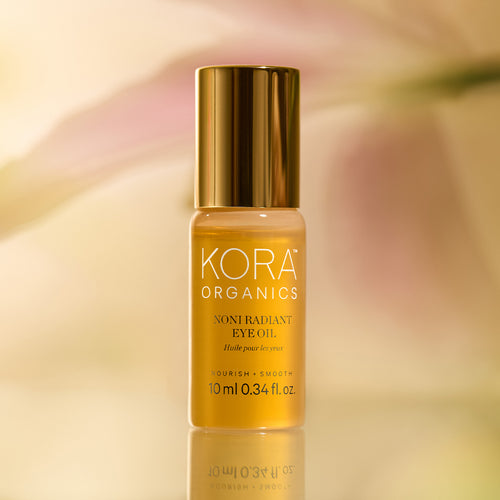
The Eye Area Deserves Specific Attention
It has fewer oil glands, less structural support, and is subject to constant mechanical movement. It ages differently, and it responds differently to ingredients. A moisturizer formulated for the face is not wrong to use there, but it is not optimized for those conditions either.
Dark circles and fine lines in the eye area are not the same problem. Dark circles are primarily a vascular and pigmentation issue, blood pooling under thin skin, or post-inflammatory hyperpigmentation from sun exposure or friction. Fine lines are a structural issue driven by collagen degradation and dehydration. A serious eye product needs to address both simultaneously, through ingredients that are potent enough to work and gentle enough not to cause the sensitivity or milia that heavier formulas often trigger.
Vitamin C Formulated for Where It Actually Needs to Work

The Kakadu Plum Vitamin C Eye Cream ($64.00) centers on Kakadu plum, a native Australian fruit that carries one of the highest recorded concentrations of natural vitamin C of any plant source.
Synthetic ascorbic acid, the form of vitamin C found in most conventional formulations, is notoriously unstable. It oxidizes quickly on exposure to light and air, which means a product that tests well at the point of manufacture may be delivering a fraction of its stated potency by the time it reaches the eye area. It also sits at a low pH to remain stable, which can cause stinging and irritation, exactly the wrong outcome for the most sensitive skin on the face.
Vitamin C derived from Kakadu plum is naturally buffered and more bioavailable in its whole-food form. It delivers the antioxidant and brightening activity without the instability or the irritation risk. For the eye area specifically, this is the difference between a product that works and one that makes the problem worse.
The formulation also supports the structural side of the equation, addressing fine lines through hydration and collagen support, so both concerns are met in a single, precisely calibrated product.
What Certification Actually Guarantees
Both products carry KORA Organics' certified organic standard, which means the ingredients are grown and processed without synthetic pesticides, herbicides, or chemical fertilizers. Certified organic ingredients contain up to 60% more antioxidants than their conventional equivalents, a difference that is directly relevant to how well a product performs, not just how cleanly it was made.
This is why the certification matters beyond ethics. It is a quality standard with measurable consequences for efficacy. When KORA Organics formulates with certified organic Kakadu plum or certified organic turmeric, the starting material is more potent. The finished product has more to work with.
The Longer View
What KORA Organics is building, product by product, formulation decision by formulation decision, is a skincare practice that compounds over time. Not a quick fix. Not a dramatic transformation promised in seven days. A consistent, intelligent approach to feeding the skin what it actually needs, through ingredients it can recognize and use.
That is a different value proposition than most of what fills a Sephora shelf. It requires more trust, more patience, and more willingness to understand why something works rather than simply whether it claims to.
For the people who have arrived at that point, who are done with the cycle of hype and disappointment and are ready to build something that lasts, KORA Organics is where that practice begins.