



(0) Items
Glow Is a Byproduct: What KORA Organics Is Actually Building
Posted by KORA Organics in The-organic-editThere is a version of skincare that treats radiance as the goal. KORA Organics treats it as the result.
That distinction matters more than it sounds. When a brand designs around outcomes rather than optics, the formulations change. The sourcing changes. The story changes. KORA Organics, founded by Miranda Kerr, was built on the conviction that skin performs best when it is supported by clean, certified organic ingredients that work with biology rather than around it. That philosophy has only grown more relevant as consumers have grown more skeptical of what they put on their skin.
The Market Has Caught Up to What KORA Knew Early
The shift happening in skincare right now is not a trend in the conventional sense. It is a recalibration. Consumers are reading ingredient labels. They are asking what "natural" actually means on a label that carries no regulatory weight. They are distinguishing between brands that use organic ingredients as a marketing accent and brands that have built their entire supply chain around certified organic standards.
KORA Organics falls firmly in the second category. Every product carries certified organic certification, which means the ingredients meet rigorous third-party standards, not internal ones. Certified organic formulations have been shown to contain significantly higher concentrations of antioxidants than conventionally sourced equivalents, which has direct implications for how well active ingredients perform in the skin. This is not a philosophical preference. It is a formulation advantage.
Alongside the clean beauty recalibration, two other shifts are reshaping what consumers prioritize: a growing interest in Ayurvedic and botanically rooted ingredients, and a pullback from harsh, stripping treatments in favor of formulas that deliver results without disruption. Both trends are visible in what KORA Organics has been doing for years.
Two Products That Reflect the Full Picture
The brand's approach becomes clearest when you look at products that sit at opposite ends of a routine. One is active and exfoliating. The other is restorative and delicate. Together, they illustrate a coherent formulation philosophy.

The Case for Turmeric Done Right
The Turmeric Brightening & Exfoliating Scrub + Mask at $56.00 is the kind of product that could easily be misread as a trend piece. Turmeric has had a long run as a buzzy ingredient, which means the market is full of products that use it as a label claim rather than a functional active.
KORA's version is different in both sourcing and application. The turmeric used is certified organic, which matters because the curcumin concentration in organically grown turmeric is measurably higher than in conventionally grown alternatives. Curcumin is the compound responsible for turmeric's antioxidant and anti-inflammatory properties. Lower concentration means lower efficacy, regardless of how prominently the ingredient is featured on the packaging.
The formula functions as both a scrub and a mask, which reflects an understanding of how real people use their time. The physical exfoliation lifts surface dullness while the mask phase allows the brightening actives to work on the skin beneath. The result is the kind of visible clarity that comes from addressing texture and tone simultaneously rather than sequentially.
This dual function also speaks to a broader consumer behavior shift: people are consolidating their routines. They want fewer products that do more, not an expanding shelf of single-purpose treatments. The Turmeric Scrub + Mask is designed for exactly that expectation.

The Eye Area as a Test of Formulation Restraint
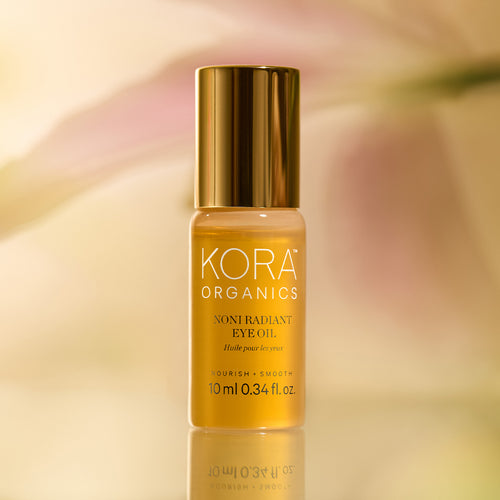
The Noni Radiant Eye Oil at $46.00 addresses one of the most technically demanding areas in skincare. The skin around the eye is thinner, more reactive, and more sensitive to both irritation and inadequate hydration than the rest of the face. Formulating effectively for this area requires restraint as much as it requires potency.
Noni, derived from the Morinda citrifolia plant, has a long history of use in traditional Polynesian and Ayurvedic wellness practices. Its documented properties include antioxidant activity and support for skin elasticity, which makes it a logical anchor ingredient for a product targeting the visible signs of fatigue and aging around the eye. KORA uses certified organic noni as a core component across multiple products, which reflects a genuine investment in the ingredient rather than an opportunistic inclusion.
The oil format is also worth noting in the context of current formulation trends. Lightweight facial oils have seen sustained growth in consumer interest as more people understand that oil-based hydration does not mean heavy or pore-clogging. For the eye area specifically, an oil can deliver lipid replenishment that water-based formulas cannot achieve as efficiently, particularly for skin that has become dry or crepey over time.
What These Two Products Share
It would be easy to treat an exfoliating scrub and an eye oil as unrelated products. They are not. They represent two sides of the same formulation principle.
| Product | Primary Function | Key Organic Active | Format | Price |
|---|---|---|---|---|
| Turmeric Brightening & Exfoliating Scrub + Mask | Exfoliation + brightening | Certified organic turmeric | Scrub/mask hybrid | $56.00 |
| Noni Radiant Eye Oil | Restoration + radiance | Certified organic noni | Lightweight oil | $46.00 |
Both use certified organic actives with documented functional properties. Both are vegan, cruelty-free, gluten-free, and non-GMO. Both are formulated to deliver visible results without relying on synthetic shortcuts. And both reflect the same underlying question that drives every KORA Organics product: what does this skin actually need, and what is the cleanest, most effective way to provide it?
The Brand Beneath the Glow
KORA Organics exists at the intersection of two things that the beauty industry has historically treated as incompatible: genuine organic standards and genuine performance. The brand's position is that these are not in tension. They are reinforcing.
That argument has become easier to make as the science around certified organic actives has developed and as consumers have grown more sophisticated about what they are reading on labels. But KORA was making it before it was a competitive advantage. That early commitment is what gives the brand its credibility now, when the market is full of brands trying to retrofit clean credentials onto conventional formulation approaches.
Radiance, in KORA's framing, is not something you apply. It is something you cultivate by consistently giving skin what it needs. The products are the evidence. The brand is the conviction behind them.