




(0) Items
Five Products. One Routine. The Cleanest Glow You'll Build All Year.
Posted by KORA Organics in The-organic-editThere's a shift happening in how people think about skincare in 2025. The maximalist era of 12-step routines and ingredient-stacking is giving way to something more intentional. According to Mintel's 2024 beauty trends report, consumers are increasingly prioritizing "fewer, better" products, with a growing emphasis on certified organic formulations and multi-functional actives over synthetic complexity. The question is no longer "how many products can I add?" It's "which ones are actually doing something?"
KORA Organics was built around exactly that philosophy. Founded by Miranda Kerr, the brand has always operated at the intersection of certified organic integrity and clinically relevant results. Every product below earns its place in a routine, and together they form something coherent: a full-body, face-to-skin glow system grounded in clean, high-performance botanicals.
Here's how to build it.
The Products at a Glance
| Product | Category | Price |
|---|---|---|
| Turmeric Glow Foaming Cleanser | Cleanser | $$48.00 |
| Kakadu Plum Vitamin C Serum | Treatment | $$79.00 |
| Active Algae Minty Mist | Treatment | $$47.00 |
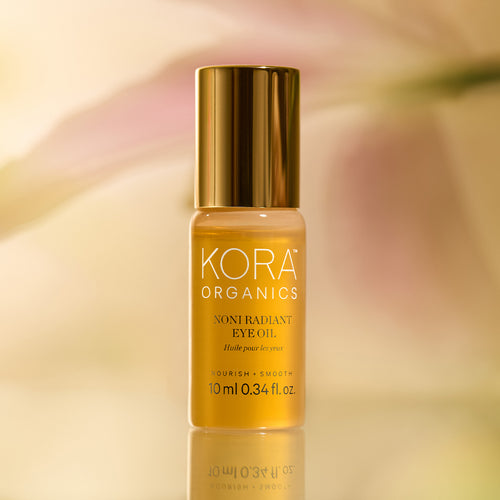
| Noni Radiant Eye Oil | Moisturizer | $$46.00 |
| Noni Glow Body Oil | Moisturizer | $$69.00 |
Start With a Clean Base That Doesn't Strip

The Turmeric Glow Foaming Cleanser ($$48.00) is the kind of cleanser that reframes what cleansing can feel like. Most foaming formulas rely on sulfates to generate lather, which creates a satisfying squeaky-clean sensation at the cost of the skin barrier. This one works differently. Certified organic turmeric, a well-documented anti-inflammatory and brightening agent, anchors the formula alongside botanical extracts that support skin tone without disrupting the microbiome.
Dermatologists have long pointed to compromised barrier function as the root cause of most skin sensitivity complaints. A cleanser that cleans without over-stripping isn't a luxury, it's the non-negotiable foundation every other product in a routine depends on. At $48.00, this one earns that role.
The Serum That Takes Vitamin C Seriously

Vitamin C remains one of the most researched topical antioxidants in skincare science. A 2023 review published in the Journal of Clinical and Aesthetic Dermatology confirmed L-ascorbic acid's role in collagen synthesis stimulation, UV-induced pigmentation reduction, and free radical neutralization. The challenge has always been stability and concentration, since most synthetic vitamin C formulations degrade quickly and irritate sensitive skin at therapeutic doses.
The Kakadu Plum Vitamin C Serum ($$79.00) addresses this with a source-first approach. Kakadu plum, native to Australia, contains the highest recorded natural concentration of vitamin C of any food source on earth, with levels up to 100 times higher than oranges. Sourcing vitamin C from a whole botanical rather than a synthetic isolate delivers the antioxidant within a complex of co-factors that support absorption and reduce the oxidative instability that makes so many vitamin C serums turn orange and lose potency within weeks.
For anyone who has cycled through vitamin C serums that either irritated their skin or simply stopped working, this formulation represents a meaningful upgrade.
A Mist That Actually Belongs in Your Routine

Face mists occupy a complicated space in skincare. Many are little more than scented water with minimal active benefit. The Active Algae Minty Mist ($$47.00) is built to be more than a refresher.
Microalgae have attracted significant attention in cosmetic formulation research over the past several years, with studies pointing to their capacity to regulate sebum production, deliver trace minerals, and support skin hydration at the cellular level. This mist uses active algae as a functional core ingredient, not a label claim, alongside a cooling peppermint element that makes it genuinely useful as both a mid-routine hydration step and a midday reset.
The trend toward hybrid products, those that serve multiple steps or moments in a routine, is one of the clearest signals in the current market. Consumers want products that justify their counter space. This one does.
The Eye Area Deserves an Oil, Not Just a Cream

The skin around the eye is structurally thinner than anywhere else on the face, with fewer sebaceous glands and a higher susceptibility to transepidermal water loss. Cream-based eye products have dominated this category for decades, but the clean beauty market is increasingly embracing facial oils for their ability to deliver lipid-replenishing actives without occlusive heaviness.
The Noni Radiant Eye Oil ($$46.00) leads with certified organic noni, a Polynesian botanical with a documented antioxidant profile and a longstanding role in traditional wellness. Noni extract contains iridoids, a class of phytochemicals studied for their anti-inflammatory properties, which makes it a logical fit for a zone of the face that reacts strongly to stress, poor sleep, and environmental exposure.
At $46.00, this is one of the most accessible entry points in the KORA Organics line, and for many people, it will be the product that converts them to the brand.
Take the Glow Below the Jawline

One of the more notable shifts in beauty consumer behavior over the past two years is the extension of skincare investment from the face to the body. The body care segment has grown substantially as consumers apply the same ingredient scrutiny to what goes on their arms and legs as what goes on their face. The demand for certified organic body products specifically has outpaced broader body care growth, driven by the same clean beauty values that fuel facial skincare purchases.
The Noni Glow Body Oil ($$69.00) meets that demand with a formula that doesn't feel like an afterthought. Certified organic noni anchors the oil alongside a blend of botanical extracts designed to nourish, soften, and impart the kind of luminosity that body lotions rarely deliver. The texture absorbs without greasiness, which is the functional test most body oils fail.
Used after showering on slightly damp skin, it seals in moisture while leaving a visible glow that no amount of shimmer-laced lotion can replicate organically.
Why These Five Work Together
The cohesion here is not accidental. Each product addresses a distinct step and a distinct concern, but they share a formulation philosophy: certified organic sourcing, botanical actives with documented efficacy, and an absence of the synthetic fillers and preservatives that compromise both skin health and environmental impact.
KORA Organics carries the COSMOS Organic certification across its range, meaning the organic claims are third-party verified, not self-declared. The brand is also certified climate neutral and uses packaging made from recycled materials, which matters to a consumer base that increasingly treats purchasing decisions as values statements.
A routine built from these five products is clean in every meaningful sense of the word.