




(0) Items
Facial Oils That Actually Hydrate and Smooth Texture (And Why Most People Use Them Wrong)
Posted by KORA Organics in The-organic-editFacial oils have a reputation problem. Half the people who try them end up breaking out or feeling greasy. The other half swear by them. The difference almost always comes down to which oil, applied in which order, with what else.
If your skin feels rough, looks dull between moisturizer applications, or has that uneven, almost sandpaper quality that no amount of exfoliation seems to fix, a well-formulated facial oil may be the missing step. Not because oils are magic, but because skin barrier function is deeply tied to lipid content, and many modern routines strip more than they replenish.
Here is what the research says, which oils are worth your attention, and how to build a routine around them.
Why Texture Problems Are Often a Barrier Problem
Rough, uneven skin texture is rarely just a surface issue. The outermost layer of the skin, called the stratum corneum, depends on a lipid matrix to stay intact. When that matrix is compromised, whether from over-cleansing, environmental stress, or simply dehydration, skin cells don't shed evenly. The result is that rough, patchy quality that catches light the wrong way.
Research published in the Journal of Investigative Dermatology has documented how disruptions to the skin's lipid barrier lead to increased transepidermal water loss (TEWL), meaning the skin loses moisture faster than it can retain it. Facial oils, particularly those rich in linoleic acid and oleic acid, help restore that lipid layer and slow moisture loss. This is not a cosmetic trick. It is basic skin physiology.
The important distinction: oils do not add water to the skin. They seal it in. This is why application order matters. Oil applied over a hydrating mist or serum locks that hydration in place. Oil applied to dry skin with no underlying moisture can actually feel occlusive without delivering lasting softness.
The Oil That Earns Its Place in This Conversation

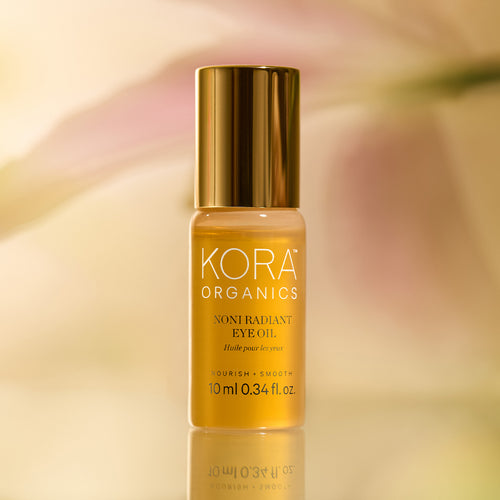
Noni Glow Face Oil — $$78.00
KORA Organics' Noni Glow Face Oil is built around certified organic noni extract, an ingredient sourced from the Pacific Islands with documented antioxidant activity. Noni contains iridoids, a class of phytonutrients shown in research to support skin repair and reduce oxidative stress at the cellular level. Paired with certified organic rosehip oil, which is naturally high in linoleic acid and vitamin A precursors, the formula addresses both barrier restoration and the kind of gradual surface renewal that smooths texture over time.
Rosehip oil specifically has been studied for its role in improving skin texture and reducing the appearance of scarring. A 2015 randomized controlled trial published in the Journal of Cosmetics, Dermatological Sciences and Applications found that rosehip oil significantly improved skin moisture, elasticity, and surface roughness compared to placebo over an eight-week period.
This is not a heavy oil. It absorbs cleanly and is designed to be layered into a routine rather than worn alone. For anyone who has tried facial oils and found them too greasy, formulation quality and ingredient ratios are almost always the reason.
The Step Before the Oil That Most People Skip
Texture improvement does not start with the oil. It starts with how you cleanse.
A cleanser that strips the skin's natural oils forces the barrier into a compromised state before any treatment product even touches the face. At that point, you are playing catch-up with every subsequent step.

Active Algae Calming Cleansing Balm — $$48.00
The Active Algae Calming Cleansing Balm uses a lipid-rich base to dissolve makeup, sunscreen, and buildup without disrupting the skin's own oil balance. Microalgae extract supports hydration retention during the cleanse itself, which means skin arrives at the next step in a more receptive state. Pineapple enzymes provide gentle exfoliation, helping with that surface roughness without the abrasiveness of physical scrubs.
For anyone dealing with texture that exfoliation has not resolved, this is worth examining. Enzymatic exfoliation works differently than mechanical or acid exfoliation. It dissolves the bonds between dead skin cells rather than physically abrading them or chemically peeling them away, making it a more consistent and less reactive approach for most skin types.
Locking Hydration Before the Oil Goes On

Active Algae Minty Mist — $$47.00
This is the step that makes the oil work harder. The Active Algae Minty Mist delivers a fine, even layer of hydration to freshly cleansed skin, giving the Noni Glow Face Oil something to seal in rather than sitting on a dry surface. Microalgae, the same core active found throughout the Active Algae line, functions as a humectant here, drawing moisture to the skin's surface.
The cooling sensation is not just sensory. Peppermint has mild vasodilatory properties, which can temporarily improve microcirculation at the skin's surface. Applied before an oil, it primes the skin for better absorption of what comes next.
The sequence matters: mist while skin is still slightly damp, let it settle for thirty seconds, then press the facial oil in with warm palms rather than rubbing it across the surface.
When Texture Is Also About Aging
Uneven texture in your thirties and beyond is often compounded by slower cell turnover. This is where a targeted anti-aging step earns its place in the routine.

The Anti-Aging Duo — $$58.00
KORA Organics' The Anti-Aging Duo pairs the Plant Stem Cell Retinol Alternative Serum with its companion moisturizer, both built around bakuchiol. Bakuchiol has been the subject of increasing clinical attention as a retinol alternative. A double-blind study published in the British Journal of Dermatology in 2019 found that bakuchiol performed comparably to retinol in reducing fine lines and improving skin texture, with significantly less irritation, dryness, and photosensitivity.
For anyone whose texture concerns include fine lines, enlarged pores, or skin that looks less refined than it used to, this duo addresses the cellular turnover side of the equation. Used alongside the Noni Glow Face Oil in the same routine, it covers both barrier restoration and active renewal, the two mechanisms that together produce lasting texture improvement.
Building the Routine
The full sequence for hydration and texture improvement looks like this:
- Cleanse with the Active Algae Calming Cleansing Balm to remove buildup without stripping the barrier.
- Mist immediately after cleansing with the Active Algae Minty Mist while skin is still slightly damp.
- Apply the Plant Stem Cell Retinol Alternative Serum from The Anti-Aging Duo if targeting fine lines and slower cell turnover.
- Follow with the companion moisturizer from the duo to lock in the serum.
- Finish with the Noni Glow Face Oil, pressed gently into the skin with warm palms as the final sealing step.
Consistency over six to eight weeks is where real texture change becomes visible. The barrier does not rebuild overnight, and surface renewal is a gradual process. What most people notice first is improved softness and a more even response to light, which is the skin's way of signaling that the lipid matrix is functioning properly again.
One More Thing Worth Knowing

If you are building out this routine, the Vegan Leather Beauty Bag at $$17.50 keeps everything organized and travel-ready. A routine only works if you actually use it, and having your products in one place removes the friction that causes people to skip steps.
The right facial oil, used in the right order, with the right supporting products, is one of the more reliable ways to address both hydration and texture in a single routine. KORA Organics' certified organic formulations are built around this logic, and the ingredient research behind them is not marketing language. It is the reason the results hold up.