



(0) Items
There is a particular kind of frustration that comes from buying into a skincare brand's promises only to find the products don't reflect them. The packaging says "clean." The marketing says "natural." But the ingredient list tells a different story. For consumers who have spent years navigating this gap between claim and reality, trust has become the scarcest resource in beauty.
KORA Organics was built as a direct answer to that problem.
Founded by Miranda Kerr, the brand began not as a business opportunity but as a personal conviction. Kerr had long prioritized organic food, holistic wellness, and conscious living before she ever launched a skincare line. The logic was straightforward: if she wouldn't put synthetic chemicals into her body, she saw no reason to put them on her skin. That belief became the structural foundation of everything KORA Organics has produced since.
What Certified Organic Actually Means Here
The word "organic" has been diluted by overuse. Brands apply it to products that contain a single organic ingredient buried beneath a list of synthetics. KORA Organics operates under a different standard. Every product in the range is certified organic, a designation that requires third-party verification, not just a label decision. Certified organic formulations contain up to 60% more antioxidants than their non-organic equivalents, according to research on organic versus conventional ingredient sourcing. That difference is not cosmetic. Antioxidants are the primary mechanism through which skincare combats oxidative stress, the process behind uneven tone, premature aging, and compromised skin barrier function.
The brand is also fully vegan, gluten-free, cruelty-free, and non-GMO across its entire range. These are not category add-ons. They are baseline requirements that shape every formulation decision.
The Problem with Starting a Skincare Routine from Scratch
One of the most common barriers to building an effective skincare routine is not motivation but orientation. Consumers who want to switch to clean beauty often face an overwhelming product landscape with no clear starting point. Buying individual products without understanding how they interact leads to redundant purchases, incompatible formulations, and routines that never quite deliver.
This is exactly the problem the Best Sellers Trio was designed to solve.

$90.00
Rather than leaving a new customer to construct a routine through trial and error, the Best Sellers Trio packages KORA Organics' most proven formulations into a single cohesive entry point. It removes the guesswork and replaces it with a curated system that reflects the brand's actual philosophy in practice. For someone transitioning from conventional skincare to certified organic products, this is a meaningful reduction in friction. The trio functions as an introduction to how KORA Organics thinks about skincare: not as isolated products, but as a coordinated approach to skin health.
The Ingredient That Defines the Brand
If there is one ingredient that runs through KORA Organics' identity, it is Noni. The Noni fruit, native to Polynesia and Southeast Asia, has been used in traditional medicine for centuries. Modern research has validated several of its properties, including its high iridoid content, which supports antioxidant activity and skin repair. Dermatologists and cosmetic chemists have increasingly recognized Noni extract as a legitimate functional ingredient rather than a botanical novelty.
KORA Organics built its formulation philosophy around Noni before the ingredient became a trend, which speaks to the brand's orientation toward evidence over aesthetics.
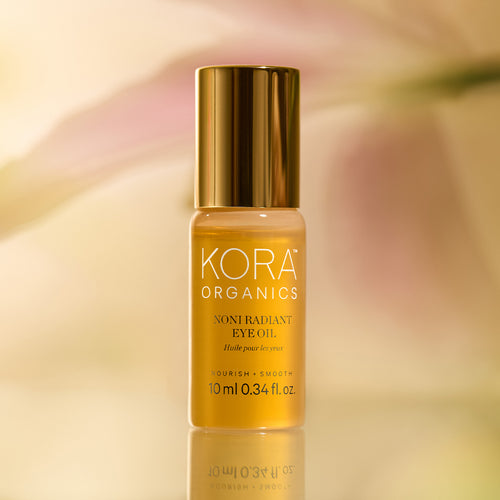
The Noni Radiant Eye Oil is one of the clearest expressions of that commitment.

$46.00
The eye area presents a specific set of challenges that general moisturizers are not equipped to address. The skin around the eyes is significantly thinner than the rest of the face, which makes it more vulnerable to dehydration, environmental damage, and the visible accumulation of fatigue. Standard face oils and creams are often too heavy for this zone, and many conventional eye products rely on silicones and synthetic peptides to create the appearance of improvement without addressing underlying causes.
The Noni Radiant Eye Oil takes a different approach. Formulated with certified organic Noni seed oil, rosehip, and a blend of botanical actives, it delivers targeted nourishment to a structurally delicate area without the heaviness or occlusion that can cause milia or congestion around the eyes. The oil format allows for rapid absorption while delivering concentrated antioxidant support to an area that is typically underserved by conventional skincare routines.
How the Products Reflect the Brand
The two products below illustrate how KORA Organics translates its values into tangible formulation decisions. The comparison is not between competing options but between two different needs the brand addresses with the same underlying philosophy.
| Product | Primary Concern Addressed | Key Certified Organic Ingredients | Price |
|---|---|---|---|
| Best Sellers Trio | Building a clean routine without guesswork | Noni, Rosehip, botanical actives across multiple formulas | $90.00 |
| Noni Radiant Eye Oil | Dehydration and fatigue in the delicate eye area | Noni seed oil, Rosehip, botanical antioxidant complex | $46.00 |
Both products demonstrate the same principle: that effective skincare requires specificity. Not a generic promise of "radiance" or "glow," but a clear understanding of what the skin needs and why a particular formulation delivers it.
Sustainability as Structure, Not Story
KORA Organics packages its products using recycled materials and holds climate neutral certification. These are operational commitments that carry real cost, not marketing language added after the fact. For brands that treat sustainability as a story to tell rather than a practice to maintain, these certifications are difficult to obtain and easy to lose. KORA Organics has maintained them because they reflect how the company actually operates.
This matters to a specific kind of consumer: one who has learned to read past brand storytelling and look for evidence. That consumer is not persuaded by aesthetics or founder celebrity alone. They want to know whether the standards hold up under scrutiny. In KORA Organics' case, they do.
The Standard Worth Holding
What KORA Organics represents is not a new category of skincare. It is a higher standard within an existing one. The formulations are certified organic. The certifications are independently verified. The ingredient choices are grounded in both traditional use and contemporary research. The products address real, specific skin concerns rather than aspirational ones.
For consumers who have grown skeptical of clean beauty claims, that specificity is the point. A brand that can explain exactly why an ingredient is in a formula, what it does, and how it was sourced is a brand that has done the work.